by admin

Toward Automated Driving in Cities using Close-to-Market Sensors, an Overview of the V-Charge Project

July 1, 2013 in Bosch, ETHZ-ASL, ETHZ-CVG, Oxford-MRG, Parma-Vislab, Publications, TUB, VW by admin

Paul Furgale et al.

IEEE Intelligent Vehicles Symposium (IVS) 2013

Future requirements for drastic reduction of CO2 production and energy consumption will lead to significant changes in the way we see mobility in the years to come.

However, the automotive industry has identified significant barriers to the adoption of electric vehicles, including reduced driving range and greatly increased refueling times. Automated cars have the potential to reduce the environmental impact of driving, and increase the safety of motor vehicle travel. The current state-of-the-art in vehicle automation requires a suite of expensive sensors. While the cost of these sensors is decreasing, integrating them into electric cars will increase the price and represent another barrier to adoption.

The V-Charge Project, funded by the European Commission, seeks to address these problems simultaneously by developing an electric automated car, outfitted with close-to-market sensors, which is able to automate valet parking and recharging for integration into a future transportation system. The final goal is the demonstration of a fully operational system including automated navigation and parking.

This paper presents an overview of the V-Charge system, from the platform setup to the mapping, perception, and planning sub-systems.


@inproceedings{furgale_iv13,
Address = {Gold Coast, Australia},
Annote = {full-conf-pb},
Author = {Paul Furgale and Ulrich Schwesinger and Martin Rufli and Wojciech Derendarz and Hugo Grimmett and Peter M\"{u}hlfellner and Stefan Wonneberger and Julian Timpner Stephan Rottmann and Bo Li and Bastian Schmidt and Thien Nghia Nguyen and Elena Cardarelli and Stefano Cattani and Stefan Br\"{u}ning and Sven Horstmann and Martin Stellmacher and Holger Mielenz and Kevin K\"{o}ser and Markus Beermann and Christian H\"{a}ne and Lionel Heng and Gim Hee Lee and Friedrich Fraundorfer and Ren\'{e} Iser and Rudolph Triebel and Ingmar Posner and Paul Newman and Lars Wolf and Marc Pollefeys and Stefan Brosig and Jan Effertz and C\'edric Pradalier and Roland Siegwart},
Booktitle = {IEEE Intelligent Vehicles Symposium (IV)},
Month = {23--26 June},
Pages = {809--816},
Title = {{Toward Automated Driving in Cities using Close-to-Market Sensors, an Overview of the V-Charge Project}},
Year = {2013}
}
Article full text

by admin

A Patch Prior for Dense 3D Reconstruction in Man-Made Environments

May 31, 2013 in ETHZ-CVG, Publications, year 2 by admin

Christian Haene, Christopher Zach, Bernhard Zeisl, and Marc Pollefeys

2012 2nd International Conference on 3D Imaging, Modeling, Processing, Visualization & Transmission

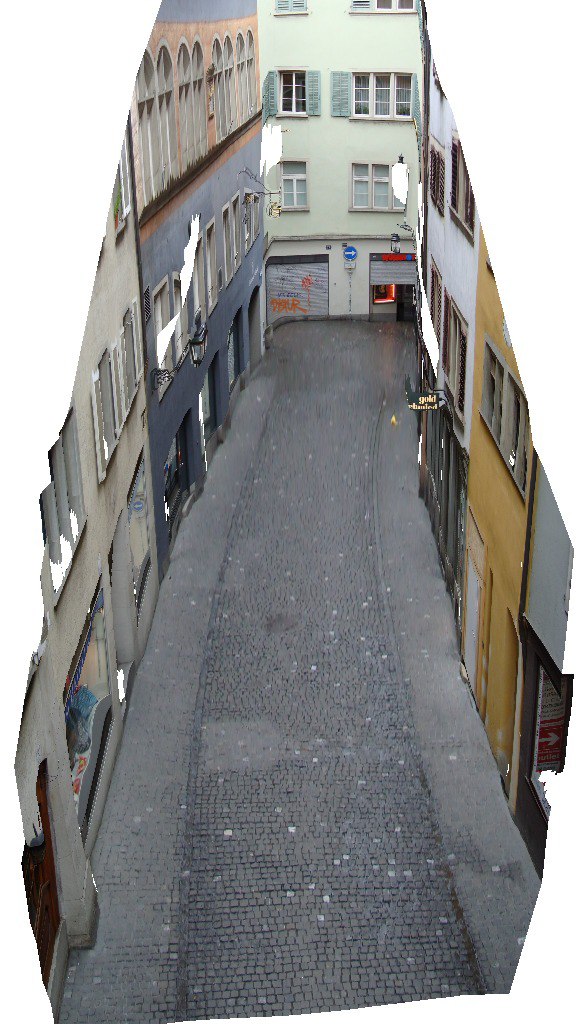
Dense 3D reconstruction in man-made environments has to contend with weak and ambiguous observations due to texture-less surfaces which are predominant in such environments. This challenging task calls for strong, domain-specific priors. These are usually modeled via regularization or smoothness assumptions. Generic smoothness priors, e.g. total variation are often not sufficient to produce convincing results. Consequently, we propose a more powerful prior directly modeling the expected local surface-structure, without the need to utilize expensive methods such as higher-order MRFs. Our approach is inspired by patch-based representations used in image processing. In contrast to the over-complete dictionaries used e.g. for sparse representations our patch dictionary is much smaller. The proposed energy can be optimized by utilizing an efficient first-order primal dual algorithm. Our formulation is in particular very natural to model priors on the 3D structure of man-made environments. We demonstrate the applicability of our prior on synthetic data and on real data, where we recover dense, piece-wise planar 3D models using stereo and fusion of multiple depth images.


@inproceedings{haene3DIMPVT13,
author = {Christian Haene and Christopher Zach and Bernhard Zeisl and Marc Pollefeys},
title = {A Patch Prior for Dense 3D Reconstruction in Man-Made Environments},
booktitle = {3DIMPVT},
year = {2013},
pages = {}
}

Article full text

by admin

Joint 3D Scene Reconstruction and Class Segmentation

May 31, 2013 in ETHZ-CVG, Publications by admin

Christian Haene, Christopher Zach, Andrea Cohen, Roland Angst, and Marc Pollefeys

2013 IEEE Conference on Computer Vision and Pattern Recognition

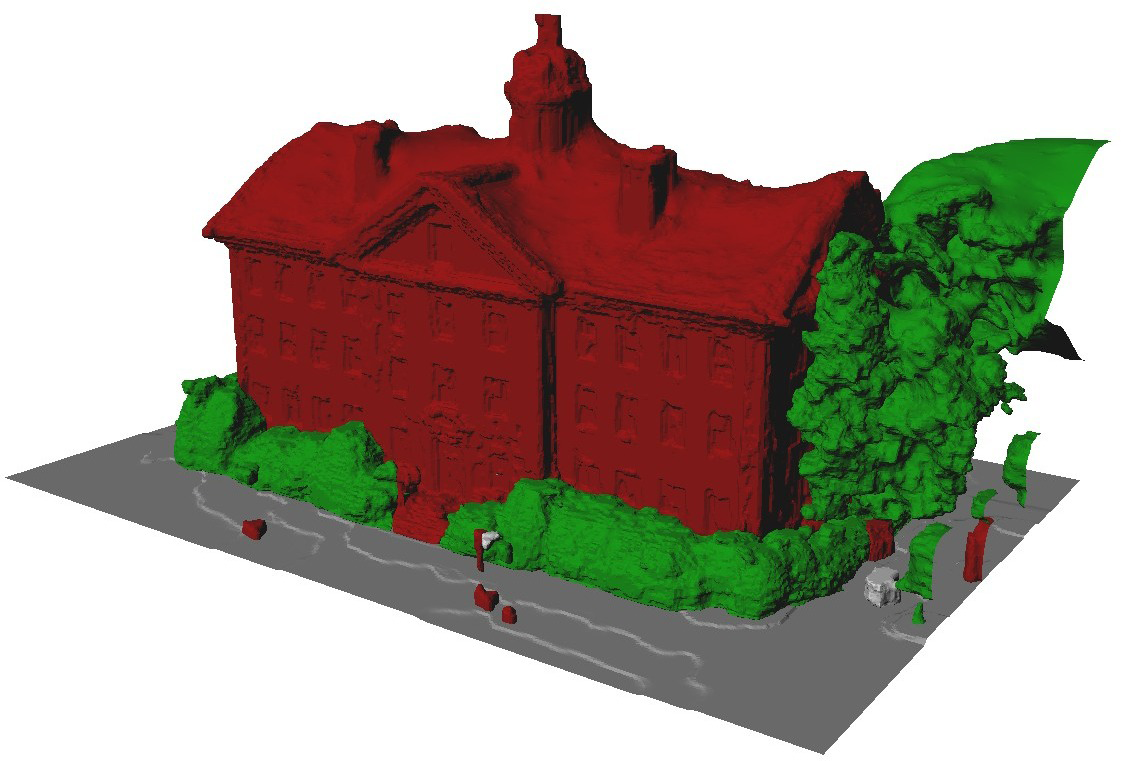
Both image segmentation and dense 3D modeling from images represent an intrinsically ill-posed problem. Strong regularizers are therefore required to constrain the solutions from being ‘too noisy’. Unfortunately, these priors generally yield overly smooth reconstructions and/or segmentations in certain regions whereas they fail in other areas to constrain the solution sufficiently. In this paper we argue that image segmentation and dense 3D reconstruction contribute valuable information to each other’s task. As a consequence, we propose a rigorous mathematical framework to formulate and solve a joint segmentation and dense reconstruction problem. Image segmentations provide geometric cues about which surface orientations are more likely to appear at a certain location in space whereas a dense 3D reconstruction yields a suitable regularization for the segmentation problem by lifting the labeling from 2D images to 3D space. We show how appearance-based cues and 3D surface orientation priors can be learned from training data and subsequently used for class-specific regularization. Experimental results on several real data sets highlight the advantages of our joint formulation


@inproceedings{haeneCVPR13,
author = {Christian Haene and
Christopher Zach and
Andrea Cohen and
Roland Angst and
Marc Pollefeys},
title = {Joint 3D Scene Reconstruction and Class Segmentation},
booktitle = {CVPR},
year = {2013},
pages = {}
}

Article full text

by admin

Motion Estimation for a Self-Driving Car with a Generalized Camera

May 31, 2013 in ETHZ-CVG, Publications by admin

Gim Hee Lee, Friedrich Fraundorfer, and Marc Pollefeys

2013 IEEE Conference on Computer Vision and Pattern Recognition

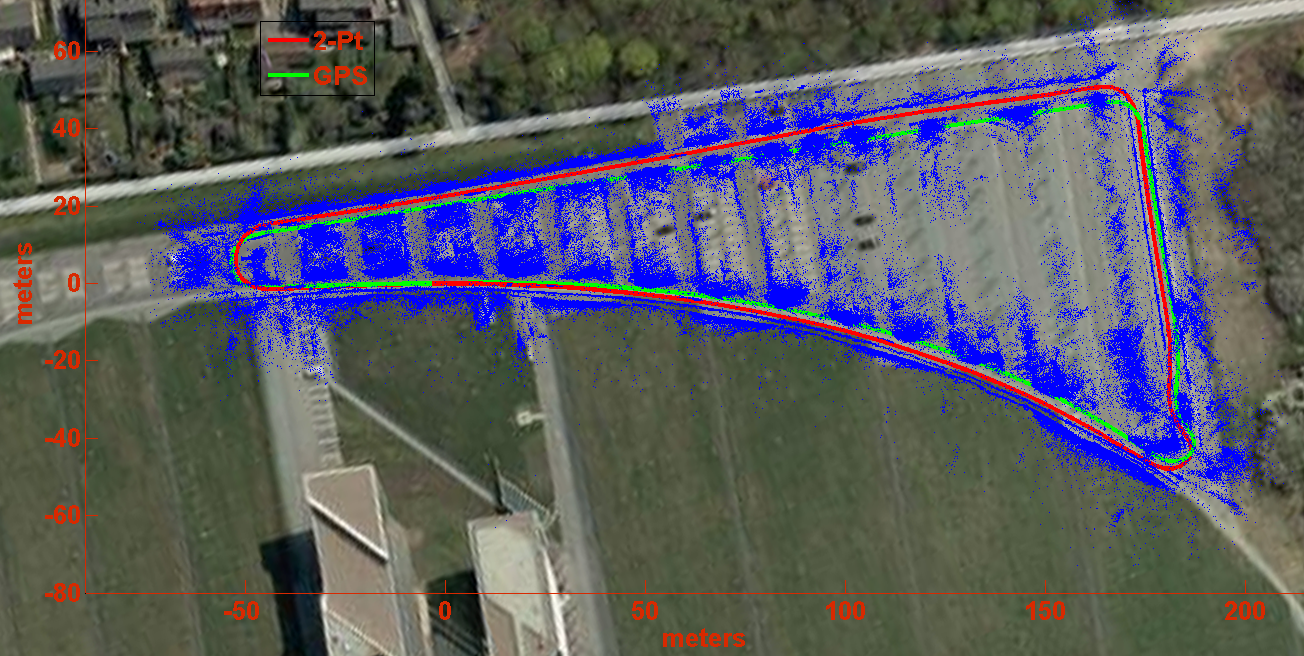
In this paper, we present a visual ego-motion estima tion algorithm for a self-driving car equipped with a close to-market multi-camera system. By modeling the multi-camera system as a generalized camera and applying the non-holonomic motion constraint of a car, we show that this leads to a novel 2-point minimal solution for the generalized essential matrix where the full relative motion including metric scale can be obtained. We provide the analytical solutions for the general case with at least one inter-camera correspondence and a special case with only intra-camera correspondences. We show that up to a maximum of 6 solutions exist for both cases. We identify the existence of degeneracy when the car undergoes straight motion in the special case with only intra-camera correspondences where the scale becomes unobservable and provide a practical al ternative solution. Our formulation can be efficiently implemented within RANSAC for robust estimation. We verify the validity of our assumptions on the motion model by comparing our results on a large real-world dataset collected by a car equipped with 4 cameras with minimal overlapping field-of-views against the GPS/INS ground truth.


@inproceedings{leeCVPR13,
author = {Gim Hee Lee and Friedrich Fraundorfer and Marc Pollefeys},
title = {Motion Estimation for a Self-Driving Car with a Generalized Camera},
booktitle = {CVPR},
year = {2013}
}

Article full text

by admin

Confidence Boosting: Improving the Introspectiveness of a Boosted Classifier for Efficient Learning

May 31, 2013 in Oxford-MRG, Publications by admin

Rudolph Triebel, Hugo Grimmett, and Ingmar Posner

2013 IEEE International Conference on Robotics and Automation (ICRA)

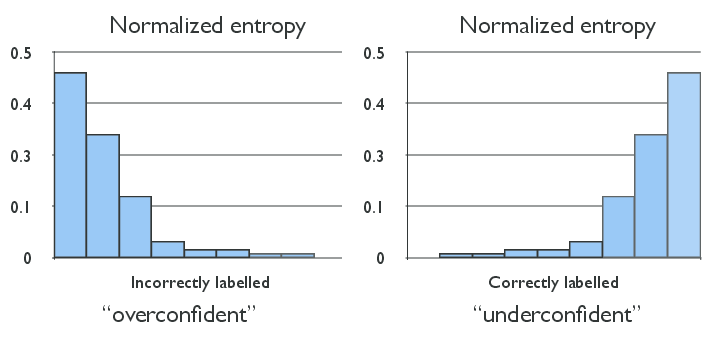
This paper concerns the recently introduced notion of introspective classification. We introduce a variant of the point-biserial correlation coefficient (PBCC) as a measure to characterise the introspective capacity of a classifier and apply it to investigate further the introspective capacity of boosting ? a well established, efficient machine learning framework commonly used in robotics. While recent evidence suggests that boosting is prone to providing overconfident classification output (i.e. it has a low introspective capacity), we investigate whether optimising this criterion directly leads to an improved introspective capacity. We show that with only a slight modification in the AdaBoost algorithm the resulting classifier becomes less confident when making incorrect predictions, rendering it significantly more useful when it comes to efficient robot decision making.


@INPROCEEDINGS { TriebelICRAWorkshop2013,
ADDRESS = { Karlsruhe, Germany },
AUTHOR = { Rudolph Triebel, Hugo Grimmett, Ingmar Posner },
BOOKTITLE = { Workshop. IEEE International Conference on Robotics and Automation (ICRA) },
MONTH = { May },
TITLE = { Confidence Boosting: Improving the Introspectiveness of a Boosted Classifier for Efficient Learning },
YEAR = { 2013 },
}

by admin

Knowing When We Don’t Know: Introspective Classification for Mission-Critical Decision Making

May 31, 2013 in Oxford-MRG, Publications by admin

Hugo Grimmett, Rohan Paul, Rudolph Triebel, and Ingmar Posner

2013 IEEE International Conference on Robotics and Automation (ICRA)

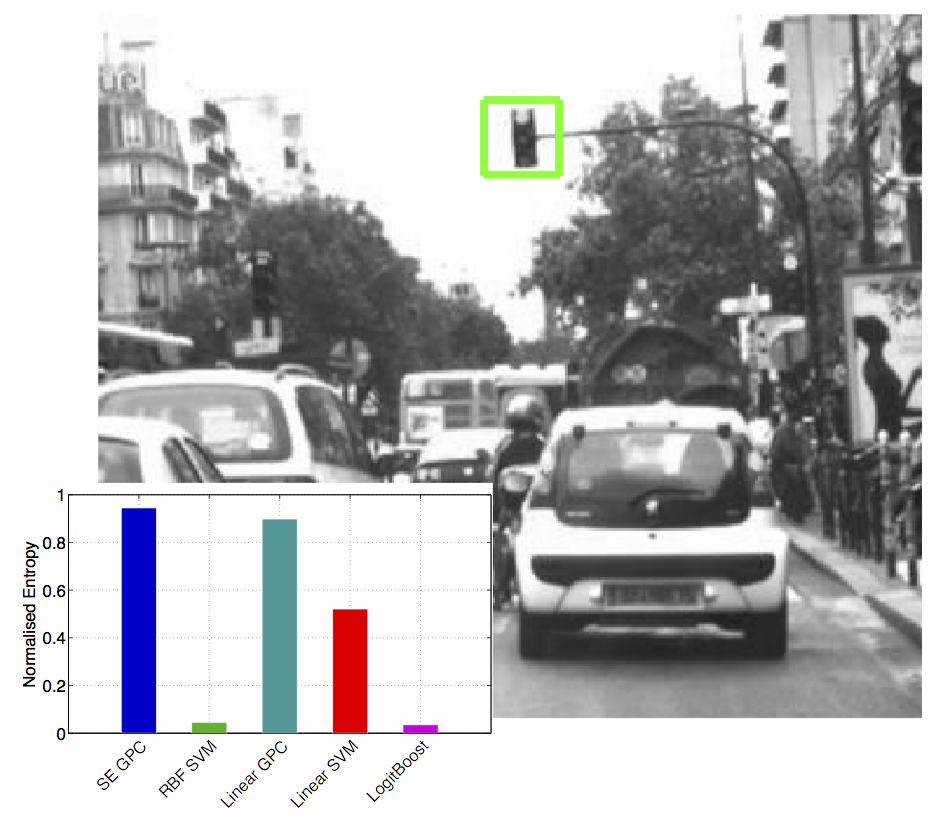
Classification precision and recall have been widely adopted by roboticists as canonical metrics to quantify the performance of learning algorithms. This paper advocates that for robotics applications, which often involve mission-critical decision making, good performance according to these standard metrics is desirable but insufficient to appropriately characterise system performance. We introduce and motivate the importance of a classifier’s introspective capacity: the ability to mitigate potentially overconfident classifications by an appropriate assessment of how qualified the system is to make a judgement on the current test datum. We provide an intuition as to how this introspective capacity can be achieved and systematically investigate it in a selection of classification frameworks commonly used in robotics: support vector machines, LogitBoost classifiers and Gaussian Process classifiers (GPCs). Our experiments demonstrate that for common robotics tasks a framework such as a GPC exhibits a superior introspective capacity while maintaining commensurate classification performance to more popular, alternative approaches.


@INPROCEEDINGS { GrimmettICRA2013,
ADDRESS = { Karlsruhe, Germany },
AUTHOR = { Hugo Grimmett, Rohan Paul, Rudolph Triebel, Ingmar Posner },
BOOKTITLE = { Proc. IEEE International Conference on Robotics and Automation (ICRA) },
MONTH = { May },
TITLE = { Knowing When We Don't Know: Introspective Classification for Mission-Critical Decision Making },
YEAR = { 2013 },
}

by admin

A Back-end System for an Autonomous Parking and Charging System for Electric Vehicle

May 31, 2013 in Publications, TUB, year 1 by admin

Julian Timpner and Lars Wolf

2012 Electric Vehicle Conference (IEVC),

Electric vehicles must be easy to use to be accepted by customers and to be successful on the market. One important part of this is the need for comfortable charging and parking.
Especially if the charging of a vehicle takes a certain amount of time, a good solution to simplify the life of the customer is necessary. The V-Charge project has the vision to provide a solution by combining autonomous valet parking with e- mobility, introducing improved parking and charging comfort to increase customer acceptance of electric vehicles. V-Charge proposes a solution for charging autonomous electric vehicles in parking places and efficiently using scarce charging resources.
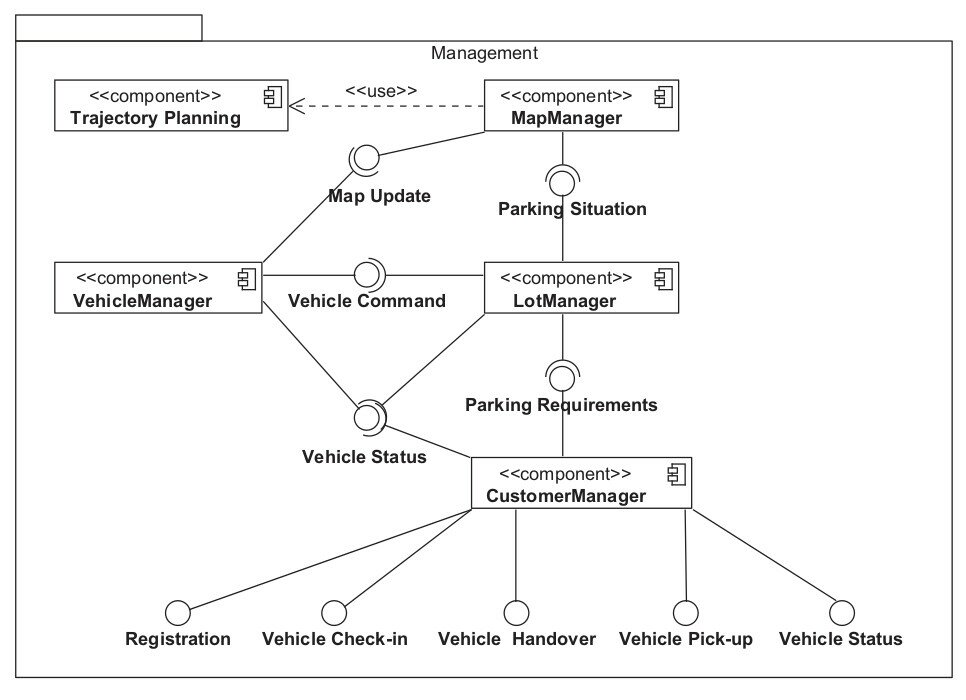
For the management of the overall system and the provided resources, a server back-end and a communication infrastructure are provided. In this paper, we present our design of a central server back-end that handles the assignment of free parking spots to autonomous electric vehicles and implements scheduling concepts for a coordinated charging strategy. A typical scenario of such a concept might be the automatic drop-off and recovery of a car in front of an airport terminal without taking care of parking or charging in person.

@INPROCEEDINGS{timpner:IEVC:2012,
author={Timpner, Julian and Wolf, Lars},
title={A Back-end System for an Autonomous Parking and Charging System for Electric Vehicles},
booktitle={Electric Vehicle Conference (IEVC), 2012 IEEE International},
address={Greenville, South Carolina, USA},
year={2012},
month={march},
volume={},
number={},
pages={1--8},
keywords={V-charge project;airport terminal;automatic drop-off concept;autonomous parking system;autonomous valet parking;car recovery;central server back-end system;charging system;coordinated charging strategy;e-mobility;electric vehicle;scarce charging resource;battery powered vehicles;scheduling;},
doi={10.1109/IEVC.2012.6183267},
ISSN={},
ibrgroups="cm",
ibrauthors="timpner wolf",
}

by admin

Efficient Charging Station Scheduling for an Autonomous Parking and Charging System

May 31, 2013 in Publications, TUB, year 1 by admin

Julian Timpner and Lars Wolf

2012 9th ACM international workshop on Vehicular inter-networking, systems, and applications

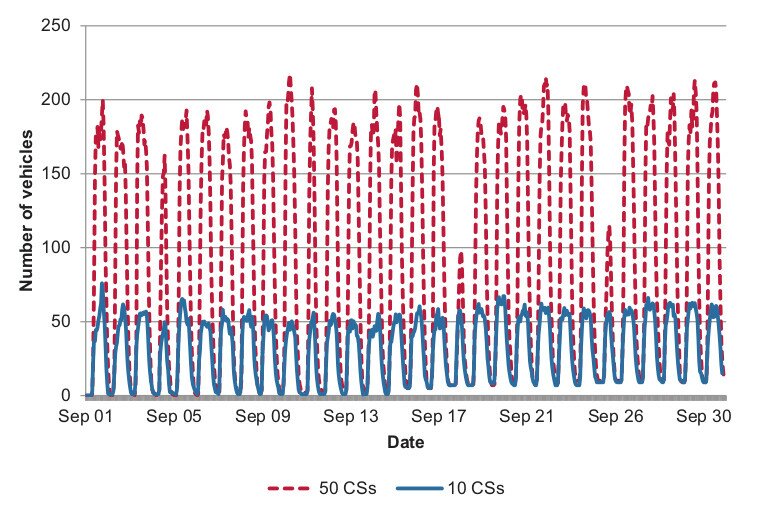
With the proliferation of electric vehicles, charging stations are a scarce resource that needs to be managed efficiently. In this paper, we therefore examine requirements for efficient charging station scheduling and propose several algorithms that we have implemented for the V-Charge system, which introduces new concepts for combining public and individual transportation, as well as coordinated recharging strategies for electric vehicles. We evaluate these strategies in different usage scenarios using real-world parking statistics.


@inproceedings{Timpner:2012:ECS:2307888.2307918,
author = {Timpner, Julian and Wolf, Lars},
title = {Efficient charging station scheduling for an autonomous parking and charging system},
booktitle = {Proceedings of the ninth ACM international workshop on Vehicular inter-networking, systems, and applications},
series = {VANET '12},
year = {2012},
isbn = {978-1-4503-1317-9},
location = {Low Wood Bay, Lake District, UK},
pages = {145--148},
numpages = {4},
url = {https://doi.acm.org/10.1145/2307888.2307918},
doi = {10.1145/2307888.2307918},
acmid = {2307918},
publisher = {ACM},
address = {New York, NY, USA},
keywords = {charging station scheduling, electric vehicle, parking management},
}


by admin

Using Multi-Camera Systems in Robotics: Efficient Solutions to the NPnP Problem

March 15, 2013 in ETHZ-ASL, Publications, year 2 by admin

Laurent Kneip, Paul Timothy Furgale, Roland Siegwart

2013 IEEE International Conference on Robotics and Automation (ICRA)

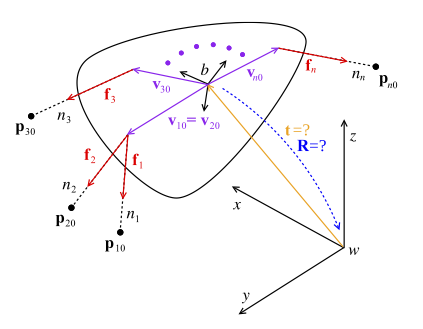
This paper introduces two novel solutions to the generalized-camera exterior orientation problem, which has a vast number of potential applications in robotics: (i) a minimal solution requiring only three point correspondences, and (ii) gPnP, an efficient, non-iterative n-point solution with linear complexity in the number of points. Already existing minimal solutions require exhaustive algebraic derivations. In contrast, our novel minimal solution is solved in a straightforward manner using the Gro ̈bner basis method. Existing n-point solutions are mostly based on iterative optimization schemes. Our n-point solution is non-iterative and outperforms existing algorithms in terms of computational efficiency. Our results present an evaluation against state-of-the-art single-camera algorithms, and a comparison of different multi-camera setups. It demonstrates the superior noise resilience achieved when using multi-camera configurations, and the efficiency of our algorithms. As a further contribution, we illustrate a possible robotic use-case of our non-perspective orientation computation algorithms by presenting visual odometry results on real data with a non-overlapping multi-camera configuration, including a comparison to a loosely coupled alternative.


@inproceedings{kneip_icra13,
Address = {Karlsruhe, Germany},
Author = {Laurent Kneip and Paul Timothy Furgale and Roland Siegwart},
Booktitle = {Proceedings of the IEEE International Conference on Robotics and Automation (ICRA), to appear.},
Month = {6-10 May},
Title = {Using Multi-Camera Systems in Robotics: Efficient Solutions to the NPnP Problem},
Year = {2013}
}
ICRA13_1065_FI.pdf