Introspective Classification for Robot Perception

November 13, 2015 in Journals, Oxford-MRG, Publications, year 4 by Ulrich Schwesinger

H. Grimmett, R. Triebel, R. Paul, and I. Posner

International Journal of Robotics Research (IJRR)
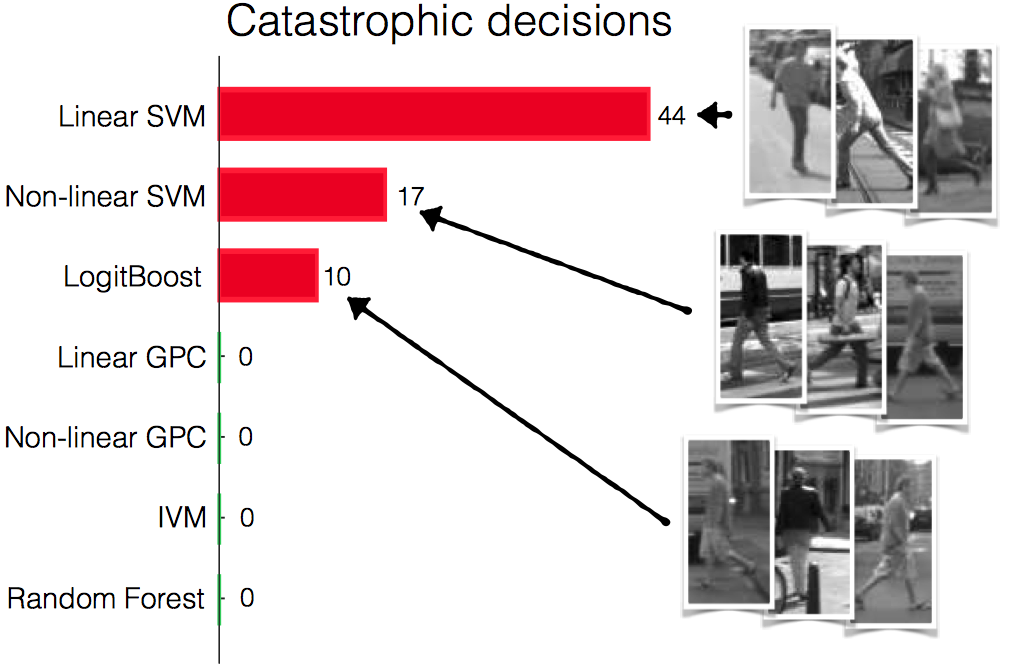
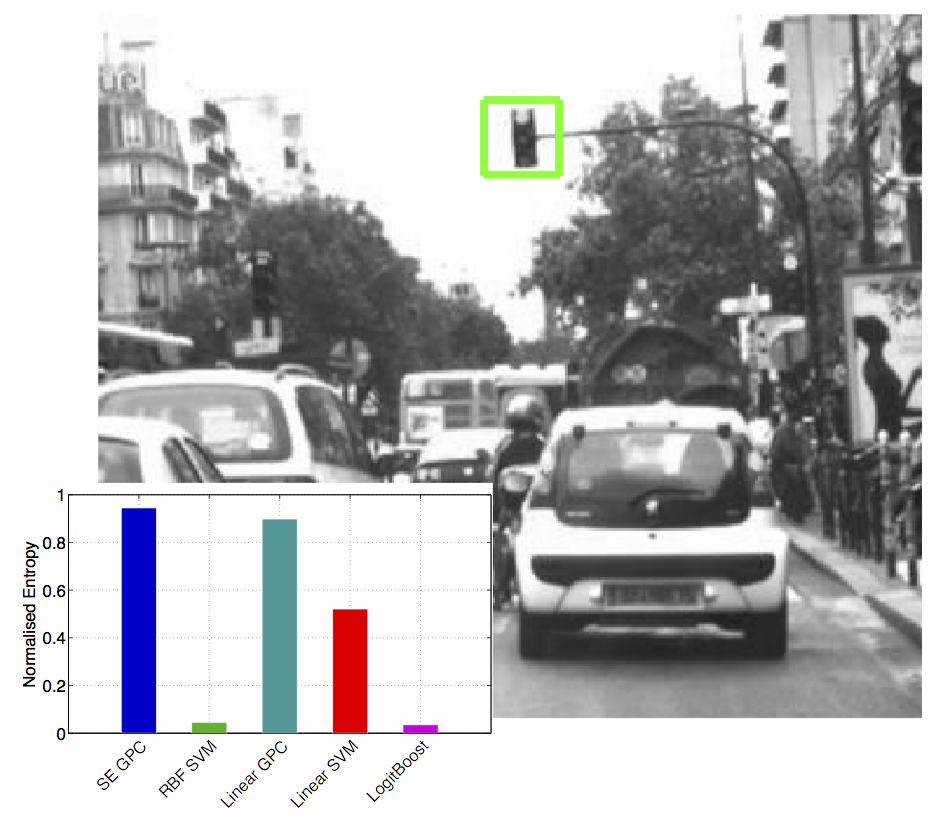
In robotics, the use of a classification framework which produces scores with inappropriate confidences will ultimately lead to the robot making dangerous decisions. In order to select a framework which will make the best decisions, we should pay careful attention to the ways in which it generates scores. Precision and recall have been widely adopted as canonical metrics to quantify the performance of learning algorithms, but for robotics applications involving mission-critical decision making, good performance in relation to these metrics is insufficient. We introduce and motivate the importance of a classifier’s introspective capacity: the ability to associate an appropriate assessment of confidence with any test case. We propose that a key ingredient for introspection is a framework’s potential to increase its uncertainty with the distance between a test datum its training data.
We compare the introspective capacities of a number of commonly used classification frameworks in both classification and detection tasks, and show that better introspection leads to improved decision-making in the context of tasks such as autonomous driving or semantic map generation.

@article{GrimmettIJRR2015,
Author = {Grimmett, Hugo and Triebel, Rudolph and Paul, Rohan and Posner, Ingmar},
Journal = {International Journal of Robotics Research (IJRR)},
Pdf = {https://www.robots.ox.ac.uk/~mobile/Papers/2015IJRR_Grimmett.pdf},
Title = {{I}ntrospective {C}lassification for {R}obot {P}erception},
Year = {2015}}
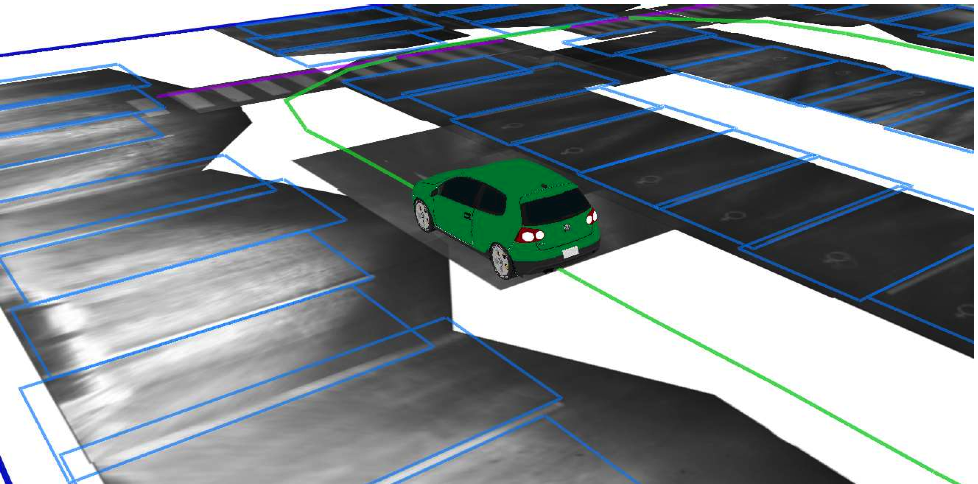
Integrating Metric and Semantic Maps for Vision-Only Automated Parking

November 13, 2015 in ETHZ-ASL, Oxford-MRG, Publications, year 4 by Ulrich Schwesinger

H. Grimmett, M. Buerki, L. Paz, P. Piniés, P. Furgale, I. Posner, and P. Newman

CONFERENCE

We present a framework for integrating two layers of map which are often required for fully automated operation: metric and semantic. Metric maps are likely to improve with subsequent visitations to the same place, while semantic maps can comprise both permanent and fluctuating features of the environment. However, it is not clear from the state of the art how to update the semantic layer as the metric map evolves.
The strengths of our method are threefold: the framework allows for the unsupervised evolution of both maps as the environment is revisited by the robot; it uses vision-only sensors, making it appropriate for production cars; and the human labelling effort is minimised as far as possible while maintaining high fidelity. We evaluate this on two different car parks with a fully automated car, performing repeated automated parking manoeuvres to demonstrate the robustness of the system.

@inproceedings{GrimmettICRA2015,
Address = {Seattle, WA, USA},
Author = {Grimmett, Hugo and Buerki, Mathias and Paz, Lina and Pini{\'e}s, Pedro and Furgale, Paul and Posner, Ingmar and Newman, Paul},
Booktitle = {{P}roceedings of the {IEEE} {I}nternational {C}onference on {R}obotics and {A}utomation ({ICRA})},
Month = {May},
Pdf = {https://www.robots.ox.ac.uk/~mobile/Papers/2015ICRA_Grimmett.pdf},
Title = {{I}ntegrating {M}etric and {S}emantic {M}aps for {V}ision-{O}nly {A}utomated {P}arking},
Year = {2015}}

by admin

Introspective Active Learning for Scalable Semantic Mapping

July 2, 2013 in Oxford-MRG, Publications, year 3 by admin

Rudolph Triebel, Hugo Grimmett, Rohan Paul, Ingmar Posner

Workshop. Robotics Science and Systems (RSS)

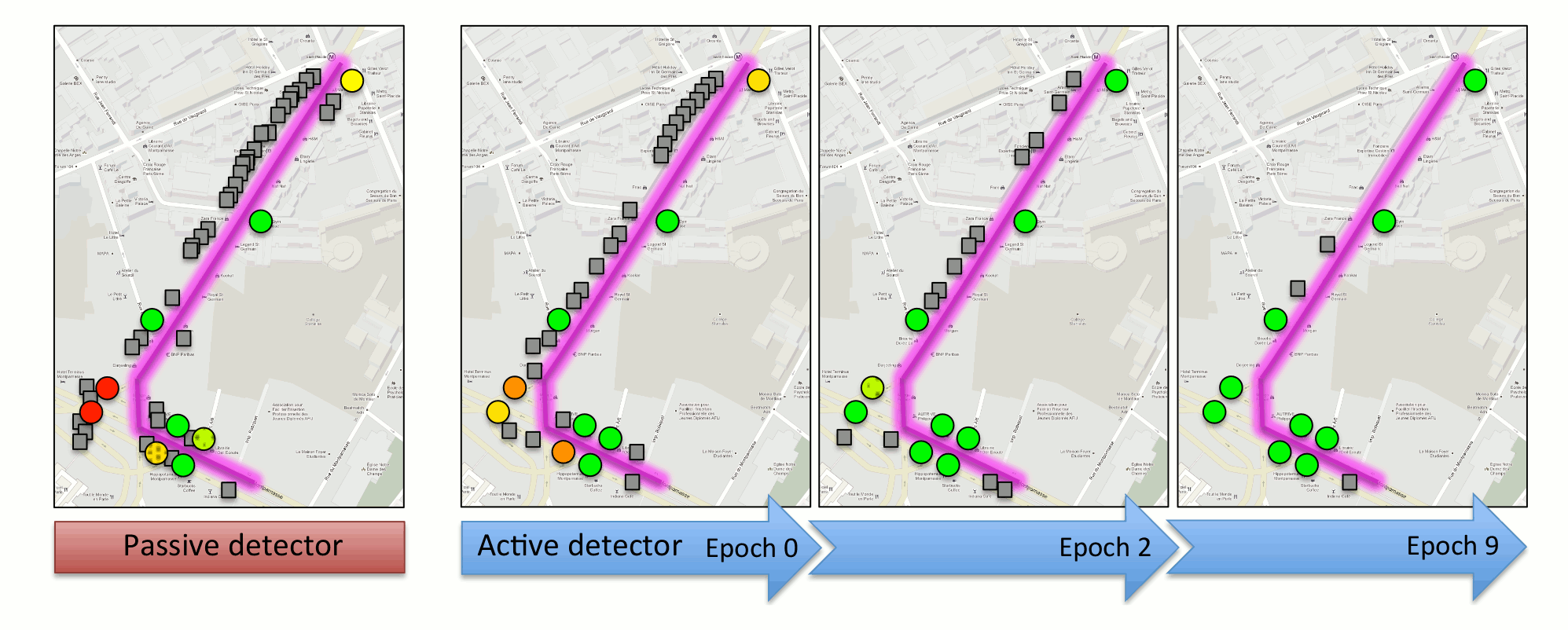
This paper proposes an active learning framework for semantic mapping in mobile robotics. In particular, our work explores the benefits of an introspective classifier over that of a more traditional non-introspective approach for active data selection. We extend the notion of introspection to a particular sparse Gaussian Process classifier, the Informative Vector Machine (IVM), and show that the use of an IVM leads to more informative questions being asked during active learning. We further leverage the information-theoretic nature of the IVM to formulate a principled mechanism for forgetting stale data. The result is an efficient and highly effective end-to-end active learning framework which outperforms both passive approaches as well as active approaches based on the more commonly used Support Vector Machine (SVM) in terms of classification performance and learning rate on a publicly available dataset.


@INPROCEEDINGS { TriebelRSSWorkshop2013,
AUTHOR = { Rudolph Triebel, Hugo Grimmett, Rohan Paul, Ingmar Posner },
BOOKTITLE = { Workshop. Robotics Science and Systems (RSS) },
MONTH = jun,
TITLE = {Introspective Active Learning for Scalable Semantic Mapping },
YEAR = { 2013 },
}

by admin

Toward Automated Driving in Cities using Close-to-Market Sensors, an Overview of the V-Charge Project

July 1, 2013 in Bosch, ETHZ-ASL, ETHZ-CVG, Oxford-MRG, Parma-Vislab, Publications, TUB, VW by admin

Paul Furgale et al.

IEEE Intelligent Vehicles Symposium (IVS) 2013

Future requirements for drastic reduction of CO2 production and energy consumption will lead to significant changes in the way we see mobility in the years to come.

However, the automotive industry has identified significant barriers to the adoption of electric vehicles, including reduced driving range and greatly increased refueling times. Automated cars have the potential to reduce the environmental impact of driving, and increase the safety of motor vehicle travel. The current state-of-the-art in vehicle automation requires a suite of expensive sensors. While the cost of these sensors is decreasing, integrating them into electric cars will increase the price and represent another barrier to adoption.

The V-Charge Project, funded by the European Commission, seeks to address these problems simultaneously by developing an electric automated car, outfitted with close-to-market sensors, which is able to automate valet parking and recharging for integration into a future transportation system. The final goal is the demonstration of a fully operational system including automated navigation and parking.

This paper presents an overview of the V-Charge system, from the platform setup to the mapping, perception, and planning sub-systems.


@inproceedings{furgale_iv13,
Address = {Gold Coast, Australia},
Annote = {full-conf-pb},
Author = {Paul Furgale and Ulrich Schwesinger and Martin Rufli and Wojciech Derendarz and Hugo Grimmett and Peter M\"{u}hlfellner and Stefan Wonneberger and Julian Timpner Stephan Rottmann and Bo Li and Bastian Schmidt and Thien Nghia Nguyen and Elena Cardarelli and Stefano Cattani and Stefan Br\"{u}ning and Sven Horstmann and Martin Stellmacher and Holger Mielenz and Kevin K\"{o}ser and Markus Beermann and Christian H\"{a}ne and Lionel Heng and Gim Hee Lee and Friedrich Fraundorfer and Ren\'{e} Iser and Rudolph Triebel and Ingmar Posner and Paul Newman and Lars Wolf and Marc Pollefeys and Stefan Brosig and Jan Effertz and C\'edric Pradalier and Roland Siegwart},
Booktitle = {IEEE Intelligent Vehicles Symposium (IV)},
Month = {23--26 June},
Pages = {809--816},
Title = {{Toward Automated Driving in Cities using Close-to-Market Sensors, an Overview of the V-Charge Project}},
Year = {2013}
}

Article full text

by admin

Confidence Boosting: Improving the Introspectiveness of a Boosted Classifier for Efficient Learning

May 31, 2013 in Oxford-MRG, Publications by admin

Rudolph Triebel, Hugo Grimmett, and Ingmar Posner

2013 IEEE International Conference on Robotics and Automation (ICRA)

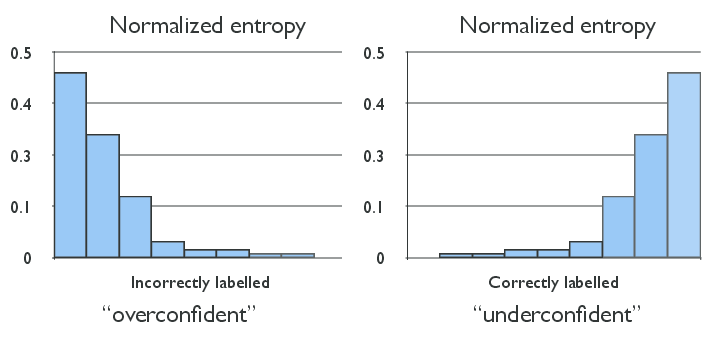
This paper concerns the recently introduced notion of introspective classification. We introduce a variant of the point-biserial correlation coefficient (PBCC) as a measure to characterise the introspective capacity of a classifier and apply it to investigate further the introspective capacity of boosting ? a well established, efficient machine learning framework commonly used in robotics. While recent evidence suggests that boosting is prone to providing overconfident classification output (i.e. it has a low introspective capacity), we investigate whether optimising this criterion directly leads to an improved introspective capacity. We show that with only a slight modification in the AdaBoost algorithm the resulting classifier becomes less confident when making incorrect predictions, rendering it significantly more useful when it comes to efficient robot decision making.


@INPROCEEDINGS { TriebelICRAWorkshop2013,
ADDRESS = { Karlsruhe, Germany },
AUTHOR = { Rudolph Triebel, Hugo Grimmett, Ingmar Posner },
BOOKTITLE = { Workshop. IEEE International Conference on Robotics and Automation (ICRA) },
MONTH = { May },
TITLE = { Confidence Boosting: Improving the Introspectiveness of a Boosted Classifier for Efficient Learning },
YEAR = { 2013 },
}

by admin

Knowing When We Don’t Know: Introspective Classification for Mission-Critical Decision Making

May 31, 2013 in Oxford-MRG, Publications by admin

Hugo Grimmett, Rohan Paul, Rudolph Triebel, and Ingmar Posner

2013 IEEE International Conference on Robotics and Automation (ICRA)

Classification precision and recall have been widely adopted by roboticists as canonical metrics to quantify the performance of learning algorithms. This paper advocates that for robotics applications, which often involve mission-critical decision making, good performance according to these standard metrics is desirable but insufficient to appropriately characterise system performance. We introduce and motivate the importance of a classifier’s introspective capacity: the ability to mitigate potentially overconfident classifications by an appropriate assessment of how qualified the system is to make a judgement on the current test datum. We provide an intuition as to how this introspective capacity can be achieved and systematically investigate it in a selection of classification frameworks commonly used in robotics: support vector machines, LogitBoost classifiers and Gaussian Process classifiers (GPCs). Our experiments demonstrate that for common robotics tasks a framework such as a GPC exhibits a superior introspective capacity while maintaining commensurate classification performance to more popular, alternative approaches.


@INPROCEEDINGS { GrimmettICRA2013,
ADDRESS = { Karlsruhe, Germany },
AUTHOR = { Hugo Grimmett, Rohan Paul, Rudolph Triebel, Ingmar Posner },
BOOKTITLE = { Proc. IEEE International Conference on Robotics and Automation (ICRA) },
MONTH = { May },
TITLE = { Knowing When We Don't Know: Introspective Classification for Mission-Critical Decision Making },
YEAR = { 2013 },
}