Query-response geocast for vehicular crowd sensing

November 13, 2015 in Journals, Publications, TUB, year 4 by Ulrich Schwesinger

Timpner, Julian and Wolf, Lars

Ad Hoc Networks
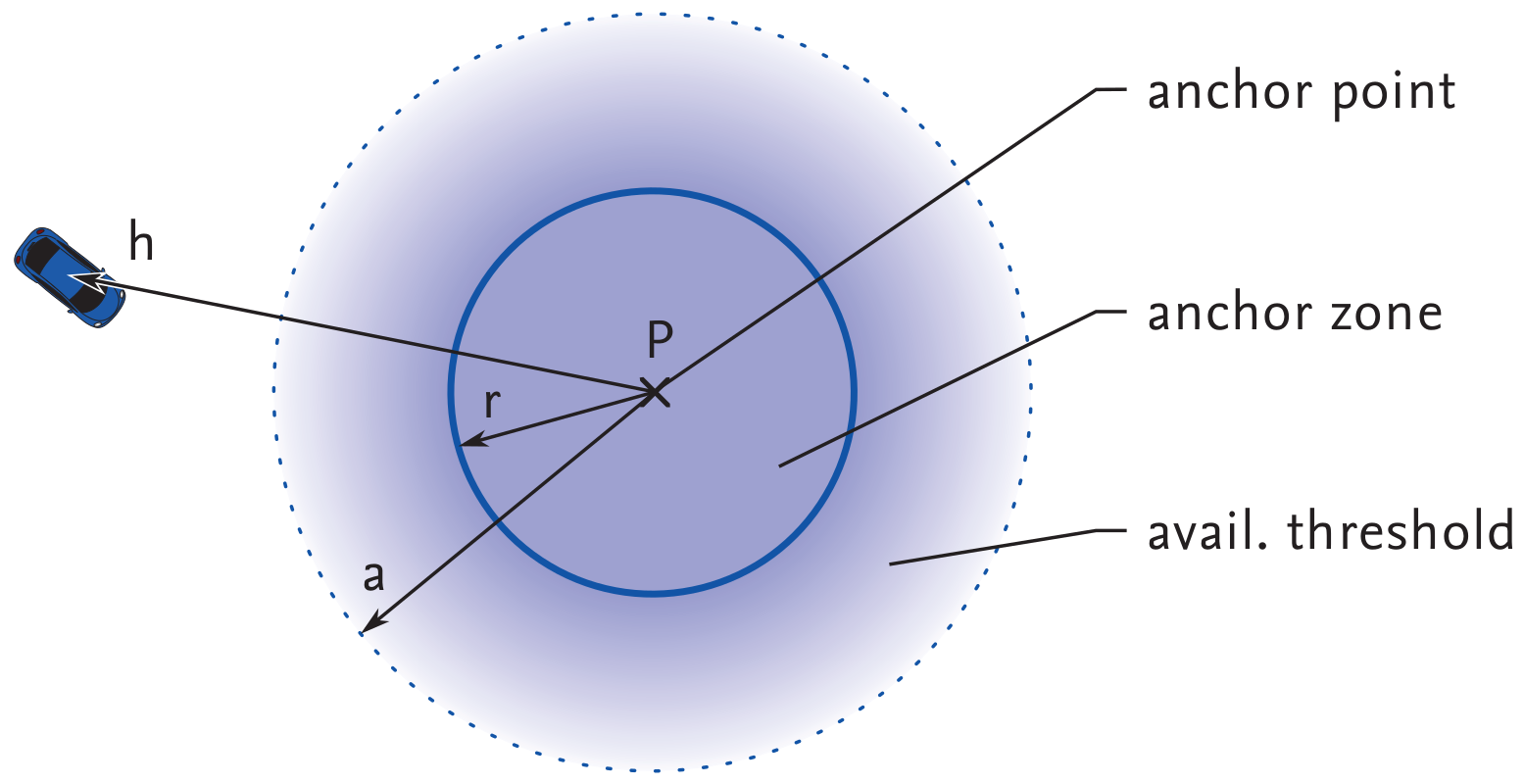
Modern vehicles are essentially mobile sensor platforms collecting a vast amount of information, which can be shared in vehicular ad hoc networks. A prime example of a resulting vehicular crowd sensing application might be the search for a parking spot in a specific geographic area. The interested vehicle sends a corresponding query into the destination area—a technique known as geocast. As the query originator, however, is likely to have moved relatively far away from the location from where the query was started by the time the response arrives, an efficient routing approach towards the originator is required. In this paper, we extend the Breadcrumb Geocast Routing (BGR), a georouting protocol for vehicular networks that is able to close this functional gap. We introduce several performance improvements. In particular, we focus on further reducing both the delivery delay and network overhead and on the dynamic adaption of breadcrumbs to the street layout, node density and other scenario-specific parameters. Extensive simulations in four different urban scenarios show a significant improvement on BGR, especially in terms of delivery delay, which can be reduced by an average of 24%.
Breadcrumb Geocast Routing Version 2 (BGR2) thus not only avoids up to 93% of the traffic overhead of Epidemic, but increases the delivery rate of the underlying georouting protocol significantly from about 48% to almost 100% even in difficult scenarios. In sum, it is shown that BGR2 and breadcrumbs in general are a feasible and efficient approach for the routing of query responses to moving nodes via geocast, enabling a variety of vehicular crowd sensing applications.


@article{Timpner:AdHoc:2015,
abstract = {},
author = {Timpner, Julian and Wolf, Lars},
doi = {10.1016/j.adhoc.2015.06.003},
issn = {15708705},
journal = {Ad Hoc Networks},
keywords = {Crowd sensing,Geocast,Query response,Routing,V2V,VANET},
month = {jun},
number = {Special Issue on Vehicular Crowd Sensing},
title = {{Query-response geocast for vehicular crowd sensing}},
url = {https://www.sciencedirect.com/science/article/pii/S1570870515001286},
year = {2015}
}
Trustworthy Parking Communities: Helping Your Neighbor to Find a Space

November 13, 2015 in Journals, Publications, TUB, year 4 by Ulrich Schwesinger

Timpner, Julian and Schürmann, Dominik and Wolf, Lars

IEEE Transactions on Dependable and Secure Computing

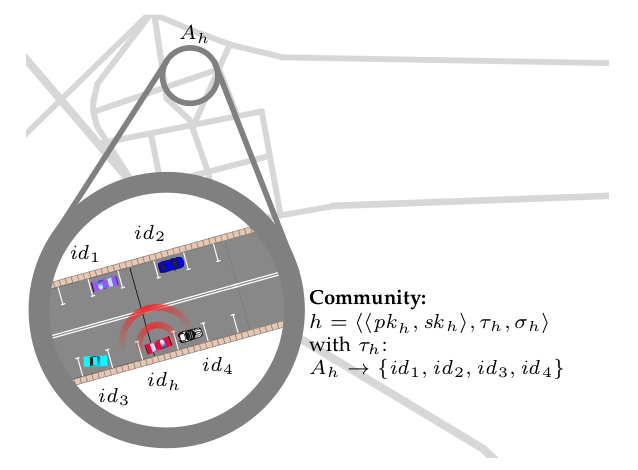
Cooperation between vehicles facilitates traffic management, road safety and infotainment applications. Cooperation, however, requires trust in the validity of the received information. In this paper, we tackle the challenge of securely exchanging parking spot availability information. Trust is crucial in order to support the decision of
whether the querying vehicle should rely on the received information about free parking spots close to its destination and thus ignore other potentially free spots on the way. Therefore, we propose Parking Communities, which provide a distributed and dynamic means to establish trusted groups of vehicles helping each other to securely find parking in their respective community area. Our approach is based on high-performance state-of-the-art encryption and signature algorithms as well as a well-understood mathematical trust rating model. This approach allows end-to-end encrypted request-response communications in combination with geocast and can be used as an overlay to existing vehicular networking technologies. We provide a comprehensive comparison with other security architectures and simulation results showing the feasibility of our approach.

@article{Timpner2014b,
author = {Timpner, Julian and Sch\"{u}rmann, Dominik and Wolf, Lars},
doi = {https://dx.doi.org/10.1109/TDSC.2015.2427838},
journal = {IEEE Transactions on Dependable and Secure Computing},
publisher = {IEEE Comput. Soc},
title = {{Trustworthy Parking Communities: Helping Your Neighbor to Find a Space}},
year = {2015}
}
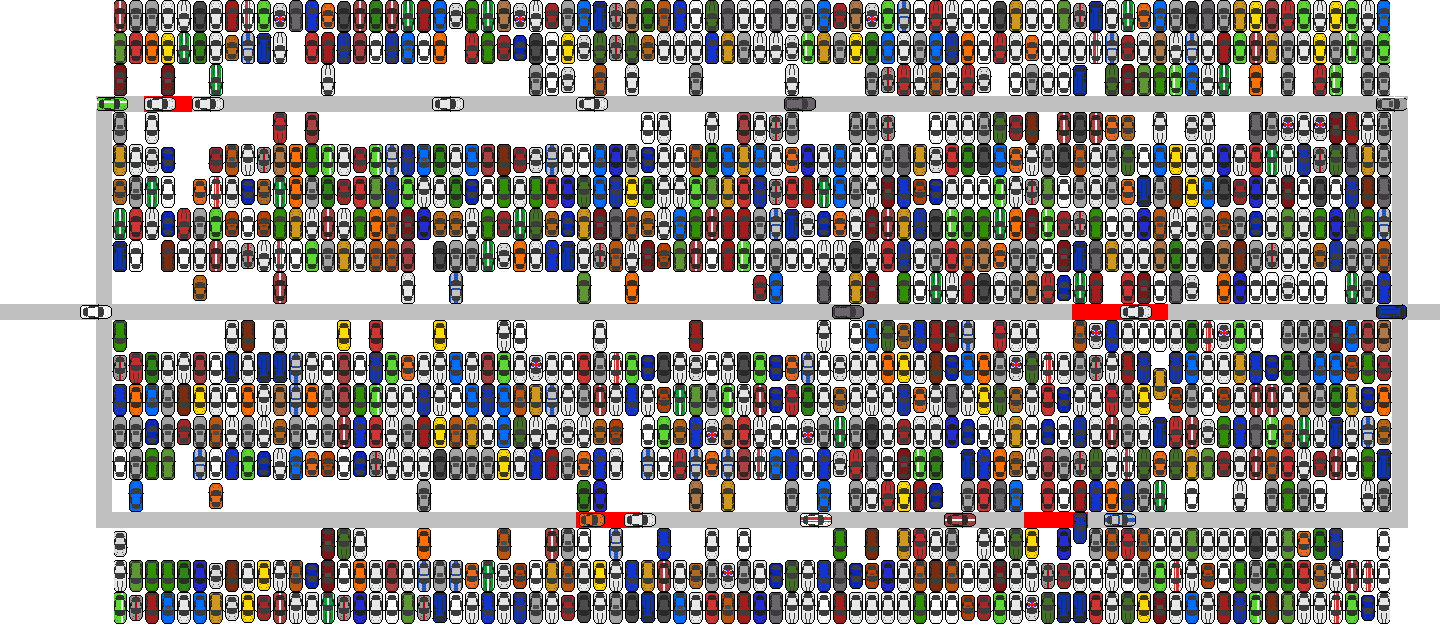
k-Stacks: High-Density Valet Parking for Automated Vehicles

November 13, 2015 in Publications, TUB, year 4 by Ulrich Schwesinger

Timpner, Julian and Friedrichs, Stephan and van Balen, Johannes and Wolf, Lars

Intelligent Vehicles Symposium (IV)

Automated valet parking not only improves driving comfort, but can have a considerable impact on the urban land- scape by reducing the required parking space. We present the first study of parking space optimization for automated valet parking with an in-depth theoretical analysis of the parking lot properties under various aspects, inluding the worst-case extraction time, total shunting distance, and the number of shunting operations (each per car). Most importantly, the proposed model bounds all these values. We verify the theoretical properties of our model in four simulated scenarios, one of which is based on real- world data from a downtown parking garage. We show that very good pick-up times of about 1 min are possible with very little overhead in terms of shunting distance and time, while providing a significantly improved parking density as compared to conventional parking lots.

@inproceedings{Timpner2015,
address = {Seoul, Korea},
author = {Timpner, Julian and Friedrichs, Stephan and van Balen, Johannes and Wolf, Lars},
booktitle = {Proceedings of the IEEE
Intelligent Vehicles Symposium (IV)},
keywords = {Automated Vehicles,Cooperative Vehicle-infrastructure Systems,V2X Communication},
month = jun,
publisher = {IEEE},
title = {{k-Stacks: High-Density Valet Parking for Automated Vehicles}},
year = {2015}
}

by admin

Vehicular Communications in the V-Charge Project

April 23, 2015 in Publications, TUB, year 4 by admin

Julian Timpner, Stephan Rottmann, and Lars Wolf

2nd GI/ITG KuVS Fachgespräch Inter-Vehicle Communication (FG-IVC 2014)

Future requirements for drastic reduction of CO2 production and energy consumption will lead to significant changes in the way we see mobility in the years to come.
However, the automotive industry has identified significant barriers to the adoption of electric vehicles, including reduced driving range and greatly increased refueling times.
The V-Charge Project, funded by the European Commission, seeks to address these problems simultaneously by developing an electric automated car, outfitted with close-to-market sensors, which is able to automate valet parking and recharging for integration into a future transportation system.
In this paper, we describe the research challenges associated with providing a wireless V2X communication infrastructure for V-Charge-enabled parking areas.

by admin

Demo: Automated Valet Parking and Charging

April 23, 2015 in Publications, TUB, year 4 by admin

Stephan Rottmann, Julian Timpner, and Lars Wolf

IEEE Vehicular Networking Conference (VNC) 2014

A model electric vehicle performing automated valet parking and charging is demonstrated.
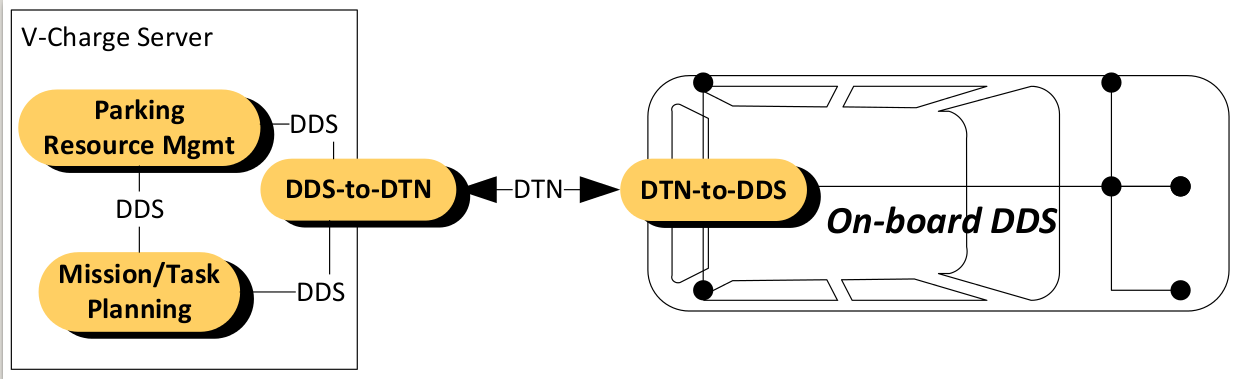
The vehicle’s missions are transmitted using WLAN based vehicle-to-infrastructure communications by a server back-end which has been developed in the EU FP7 project V-Charge.


@inproceedings{Rottmann:VNC:14,
address = {Paderborn, Germany},
doi = {https://dx.doi.org/10.1109/VNC.2014.7013348},
author = {Rottmann, Stephan and Timpner, Julian and Wolf, Lars C},
booktitle = {Proceedings of the IEEE Vehicular Networking Conference (VNC)},
keywords = {Automated valet parking,Demonstrator,V2I,Vehicular Communications},
month = dec,
publisher = {IEEE},
title = {{Demo: Automated Valet Parking and Charging}},
year = {2014},
pages = {207--208},
}

by admin

Breadcrumb Routing: Query-Reponse Geocast for Mobile Originators in Vehicular Networks

April 23, 2015 in Publications, TUB, year 4 by admin

Julian Timpner, Mario Wozenilek, and Lars Wolf

IEEE Vehicular Networking Conference (VNC) 2014

Vehicular ad hoc networks allow connected vehicles to exchange and share information in order to improve traffic efficiency and safety as well as to provide infotainment functions.
In order to cope with the challenging network conditions of the vehicular domain (e.g., intermittent connectivity), a disruption-tolerant networking architecture is suitable.
In contrast to push-based communications (e.g, cooperative awareness messages) used in many proposed vehicular applications, we focus on a query-response model for requesting sensor information.
Of particular interest to us is the question how vehicular queries can be efficiently routed to a destination area in such challenged environments, and, more importantly, how the response can be routed back to a moving query originator.
We therefore present BGR, a novel disruption-tolerant georouting protocol based on a trail of breadcrumbs left by the query originator.
As an overlay protocol, BGR can be used on top of different georouting mechanisms, providing an efficient means to address moving originators.
We study the influence of parameters, e.g., breadcrumb size and distance, and prove the effectiveness of the proposed solution in an extensive experimental evaluation, showing that BGR achieves significantly higher delivery rates compared to traditional geocast approaches, while avoiding up to 97% of the traffic overhead of Epidemic and PRoPHET routing.


@inproceedings{Timpner:VNC:2014,
address = {Paderborn, Germany},
author = {Timpner, Julian and Wozenilek, Mario and Wolf, Lars},
booktitle = {Proceedings of the IEEE Vehicular Networking Conference (VNC)},
keywords = {DTN,Georouting,V2V,VANET},
doi = {https://dx.doi.org/10.1109/VNC.2014.7013308},
month = dec,
publisher = {IEEE},
pages = {49--56},
title = {{Breadcrumb Routing: Query-Reponse Geocast for Mobile Originators in
Vehicular Networks}},
year = {2014},
}

by admin

Design and Evaluation of Charging Station Scheduling Strategies for Electric Vehicles

January 21, 2014 in Journals, Publications, TUB, year 3 by admin

Julian Timpner and Lars C. Wolf

IEEE Transactions on Intelligent Transportation Systems (Journal)

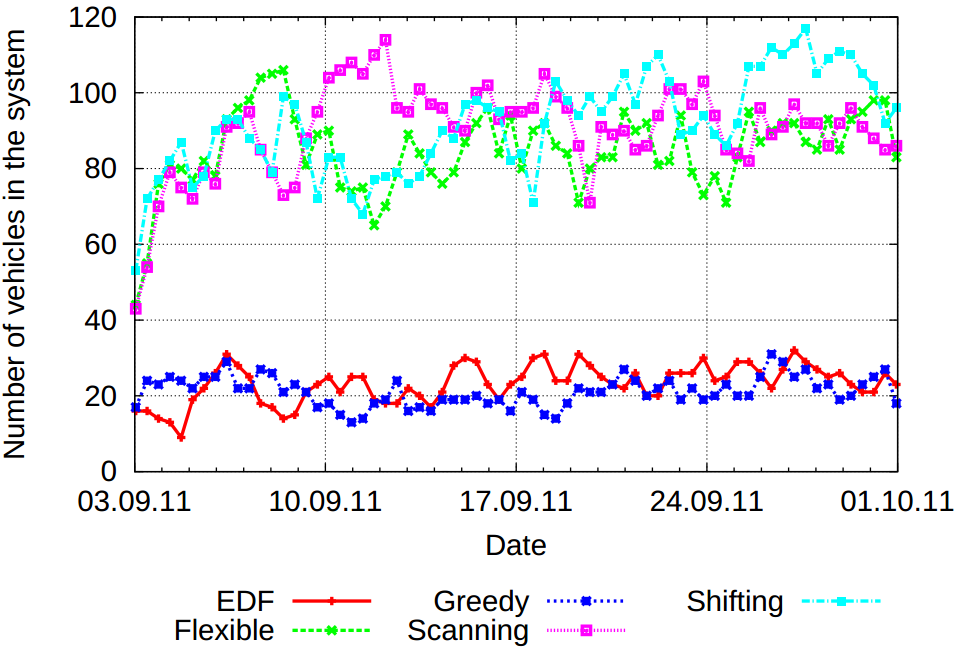
Electric vehicles (EVs) still have relatively long and frequent charging cycles. Moreover, charging resources are typically limited and must therefore be used efficiently. The V-Charge project has the vision to provide a solution by combining autonomous valet parking with e-mobility, introducing improved parking and charging comfort. V-Charge proposes a solution for charging autonomous EVs in parking places and efficiently using scarce charging resources, thus simplifying the life of the customer and increasing the feasibility of EVs. For the management of parking lots and charging resources, V-Charge provides a server back end and a communication infrastructure. In this paper, we present our design of scheduling concepts for a coordinated charging strategy that is implemented by this back end. Through intensive simulations, we show that the V-Charge server is able to efficiently handle realistic parking volume and performs well in fulfilling customer requirements, e.g., energy demand for the next driving tasks. Moreover, we evaluate the suitability of various scheduling strategies in different usage scenarios. For the simulation setup, real-world parking statistics obtained from Hamburg Airport and the City of Braunschweig, Germany, are used.


@article{Timpner:TITS:2013,
author = {Timpner, Julian and Wolf, Lars},
doi = {10.1109/TITS.2013.2283805},
journal = {IEEE Transactions on Intelligent Transportation Systems},
publisher = {IEEE},
title = {{Design and Evaluation of Charging Station Scheduling Strategies for Electric Vehicles}},
year = {2013},
month=nov,
volume=PP,
number=99,
issn={1524-9050},
URL={https://ieeexplore.ieee.org/xpl/articleDetails.jsp?arnumber=6651804},
}

by admin

Estimation of Vehicular Connectivity in Autonomous Parking Scenarios

January 21, 2014 in Journals, Publications, TUB, year 3 by admin

Tobias Pögel, Julian Timpner, Stephan Rottmann and Lars C. Wolf

PIK – Praxis der Informationsverarbeitung und Kommunikation (Journal)

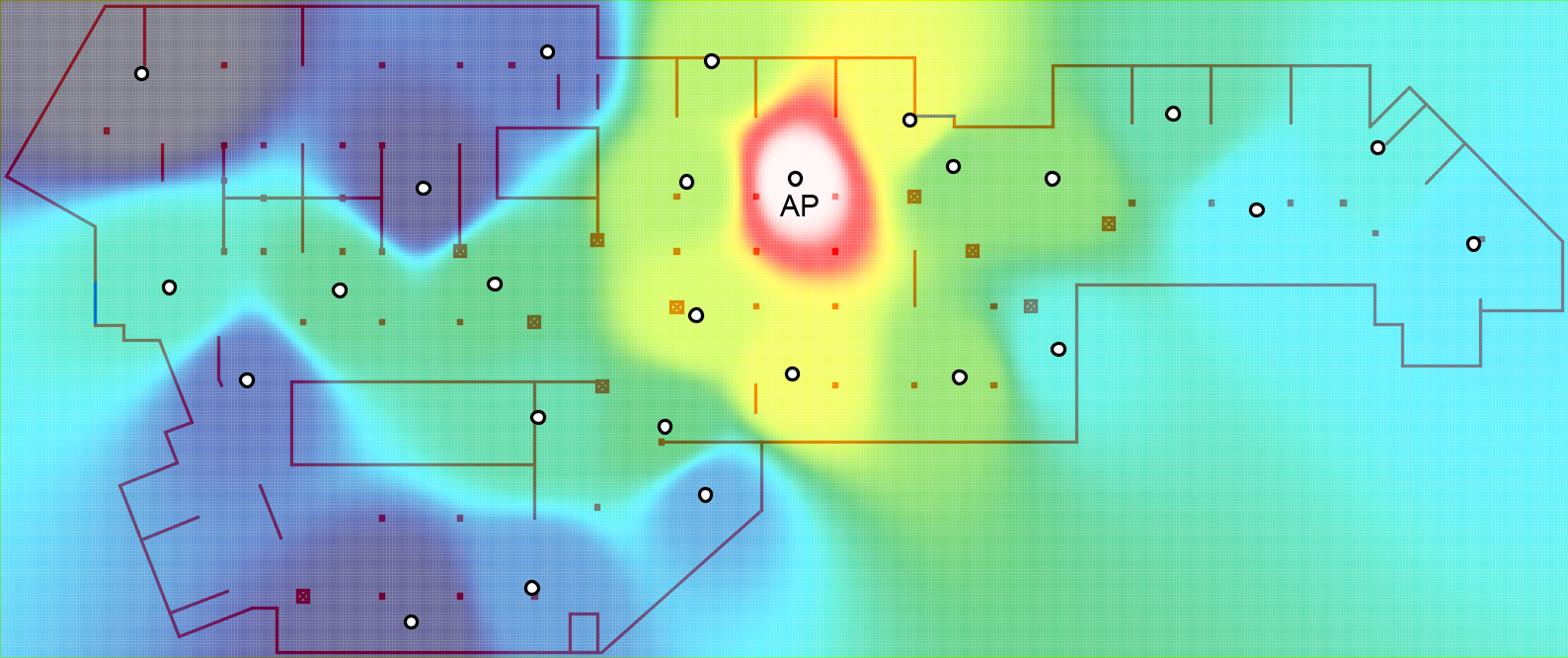
In this paper different parking scenarios for autonomous vehicles are considered. For control and monitoring purposes reliable Wi–Fi-based communication between the vehicles and a back-end is needed. It must be ensured that potential QoS requirements of different applications are met and that vehicles do not hit so-called “white spots” without any network connectivity. The network properties are represented and estimated by a Connectivity Map. For this purpose, network and measurement data are continuously collected so that other vehicles can be provided with the newly gained knowledge, which allows the planning of the proposed scenarios. This paper shows potential QoS requirements and discusses the necessary steps for the realization of such a Connectivity Map.
In addition to the automated continuous collection of relevant network parameters as a byproduct of vehicular communications, the mapping of the scenarios in terms of floor plans with additional meta-information as well as the representation of connectivity properties are shown.
We outline our vision for using the developed Connectivity Map for advanced parking management decisions.


@ARTICLE{Poegel:PIK:2013,
AUTHOR={Tobias {P{\"o}gel} and Julian Timpner and Stephan Rottmann and Lars C Wolf},
TITLE="Estimation of Vehicular Connectivity in Autonomous Parking Scenarios",
JOURNAL="PIK - Praxis der Informationsverarbeitung und Kommunikation",
PAGES={243-248},
VOLUME=36,
NUMBER=4,
DAYS=1,
MONTH=dec,
YEAR=2013,
URL={https://www.degruyter.com/view/j/piko-2013-36-issue-4/pik-2013-0026/pik-2013-0026.xml},
}

by admin

Secure Smartphone-based Registration and Key Deployment for Vehicle-to-Cloud Communications

November 28, 2013 in Publications, TUB, year 3 by admin

Julian Timpner, Domink Schürmann, and Lars Wolf

ACM Workshop on Security, Privacy and Dependability for Cyber Vehicles (CyCAR ’13)

Intelligent Transportation Systems that rely on Vehicle-to- Cloud communications are emerging. Of particular inter- est to us is the question how drivers can securely register their vehicle with cloud services and deploy keys for secur- ing vehicular communications. We therefore present a secure smartphone-based registration and key deployment process for these applications. We combine an adapted OAuth flow for Smartphone-to-Cloud communications with a novel key deployment mechanism for Public Key Infrastructures in ve- hicular networks. The primary contributions of the proposed key deployment process are a high degree of independence from central authorities and feasible security audits due to an open protocol design. As an instance of future Intelligent Transportation System applications that facilitate Vehicle- to-Cloud communications, we utilize the V-Charge project as a running example to discuss potential attack scenarios and their mitigations.


@inproceedings{Timpner:CyCAR:2013,
author = {Timpner, Julian and Sch\"{u}rmann, Dominik and Wolf, Lars},
title = {{Secure Smartphone-based Registration and Key Deployment for
Vehicle-to-Cloud Communications}},
booktitle = {Proceedings of the ACM Workshop on Security, Privacy and
Dependability for Cyber Vehicles (CyCAR '13)},
month = nov,
doi = {10.1145/2517968.2517970},
isbn = {978-1-4503-2487-8},
year = {2013},
pages = {31--36},
address = {Berlin, Germany},
publisher = {ACM Press}
}

by admin

Toward Automated Driving in Cities using Close-to-Market Sensors, an Overview of the V-Charge Project

July 1, 2013 in Bosch, ETHZ-ASL, ETHZ-CVG, Oxford-MRG, Parma-Vislab, Publications, TUB, VW by admin

Paul Furgale et al.

IEEE Intelligent Vehicles Symposium (IVS) 2013

Future requirements for drastic reduction of CO2 production and energy consumption will lead to significant changes in the way we see mobility in the years to come.

However, the automotive industry has identified significant barriers to the adoption of electric vehicles, including reduced driving range and greatly increased refueling times. Automated cars have the potential to reduce the environmental impact of driving, and increase the safety of motor vehicle travel. The current state-of-the-art in vehicle automation requires a suite of expensive sensors. While the cost of these sensors is decreasing, integrating them into electric cars will increase the price and represent another barrier to adoption.

The V-Charge Project, funded by the European Commission, seeks to address these problems simultaneously by developing an electric automated car, outfitted with close-to-market sensors, which is able to automate valet parking and recharging for integration into a future transportation system. The final goal is the demonstration of a fully operational system including automated navigation and parking.

This paper presents an overview of the V-Charge system, from the platform setup to the mapping, perception, and planning sub-systems.


@inproceedings{furgale_iv13,
Address = {Gold Coast, Australia},
Annote = {full-conf-pb},
Author = {Paul Furgale and Ulrich Schwesinger and Martin Rufli and Wojciech Derendarz and Hugo Grimmett and Peter M\"{u}hlfellner and Stefan Wonneberger and Julian Timpner Stephan Rottmann and Bo Li and Bastian Schmidt and Thien Nghia Nguyen and Elena Cardarelli and Stefano Cattani and Stefan Br\"{u}ning and Sven Horstmann and Martin Stellmacher and Holger Mielenz and Kevin K\"{o}ser and Markus Beermann and Christian H\"{a}ne and Lionel Heng and Gim Hee Lee and Friedrich Fraundorfer and Ren\'{e} Iser and Rudolph Triebel and Ingmar Posner and Paul Newman and Lars Wolf and Marc Pollefeys and Stefan Brosig and Jan Effertz and C\'edric Pradalier and Roland Siegwart},
Booktitle = {IEEE Intelligent Vehicles Symposium (IV)},
Month = {23--26 June},
Pages = {809--816},
Title = {{Toward Automated Driving in Cities using Close-to-Market Sensors, an Overview of the V-Charge Project}},
Year = {2013}
}

Article full text