by
by Vehicle detection for autonomous parking using a Soft-Cascade AdaBoost classifier
September 1, 2014 in Parma-Vislab, Publications, year 4 by admin
Alberto Broggi, Elena Cardarelli, Stefano Cattani, Paolo Medici, and Mario Sabbatelli
IEEE Intelligent Vehicles Symposium 2014
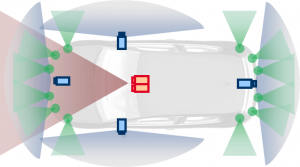 This paper presents a monocular algorithm for front and rear vehicle detection, developed as part of the FP7 V-Charge project’s perception system. The system is made of an AdaBoost classifier with Haar Features Decision Stump. It processes several virtual perspective images, obtained by un-warping 4 monocular fish-eye cameras mounted all-around an autonomous electric car. The target scenario is the automated valet parking, but the presented technique fits well in any general urban and highway environment. A great attention has been given to optimize the computational performance. The accuracy in the detection and a low computation costs are provided by combining a multiscale detection scheme with a Soft-Cascade classifier design. The algorithm runs in real time on the project’s hardware platform.
The system has been tested on a validation set, compared with several AdaBoost schemes, and the corresponding results and statistics are also reported.
                      @inproceedings{iv2014vcharge,

                      author="Alberto Broggi AND Elena Cardarelli AND Stefano Cattani AND Paolo Medici AND Mario Sabbatelli",

                      title="{Vehicle detection for autonomous parking using a Soft-Cascade AdaBoost classifier}",

                      booktitle = "Procs.~IEEE Intelligent Vehicles Symposium 2014",

                      pages="912--917",

                      year=2014,

                      address = "Dearbon, MI, USA",

                      month=jun

                      }