by
by A Patch Prior for Dense 3D Reconstruction in Man-Made Environments
May 31, 2013 in ETHZ-CVG, Publications, year 2 by admin
Christian Haene, Christopher Zach, Bernhard Zeisl, and Marc Pollefeys
2012 2nd International Conference on 3D Imaging, Modeling, Processing, Visualization & Transmission
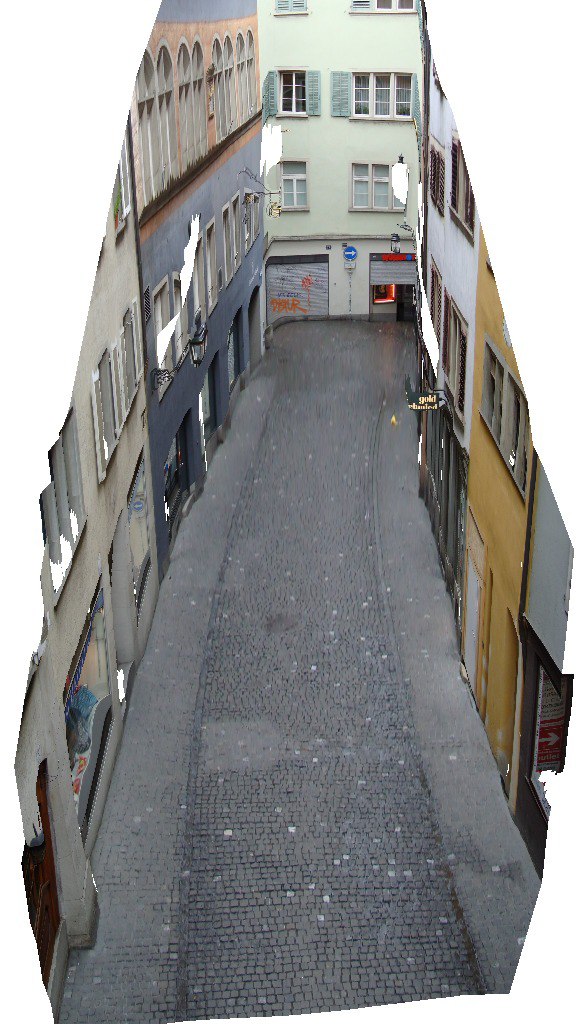 Dense 3D reconstruction in man-made environments has to contend with weak and ambiguous observations due to texture-less surfaces which are predominant in such environments. This challenging task calls for strong, domain-specific priors. These are usually modeled via regularization or smoothness assumptions. Generic smoothness priors, e.g. total variation are often not sufficient to produce convincing results. Consequently, we propose a more powerful prior directly modeling the expected local surface-structure, without the need to utilize expensive methods such as higher-order MRFs. Our approach is inspired by patch-based representations used in image processing. In contrast to the over-complete dictionaries used e.g. for sparse representations our patch dictionary is much smaller. The proposed energy can be optimized by utilizing an efficient first-order primal dual algorithm. Our formulation is in particular very natural to model priors on the 3D structure of man-made environments. We demonstrate the applicability of our prior on synthetic data and on real data, where we recover dense, piece-wise planar 3D models using stereo and fusion of multiple depth images.
                      @inproceedings{haene3DIMPVT13,

                      author = {Christian Haene and Christopher Zach and Bernhard Zeisl and Marc Pollefeys},

                      title = {A Patch Prior for Dense 3D Reconstruction in Man-Made Environments},

                      booktitle = {3DIMPVT},

                      year = {2013},

                      pages = {}

                      }