360° detection and tracking algorithm of both pedestrian and vehicle using fisheye images

June 4, 2015 in Publications, year 4

Massimo Bertozzi, Luca Castangia, Stafano Cattani, Antonio Prioletti, and Pietro Versari

IEEE Intelligent Vehicles Symposium 2015 (IV2015)
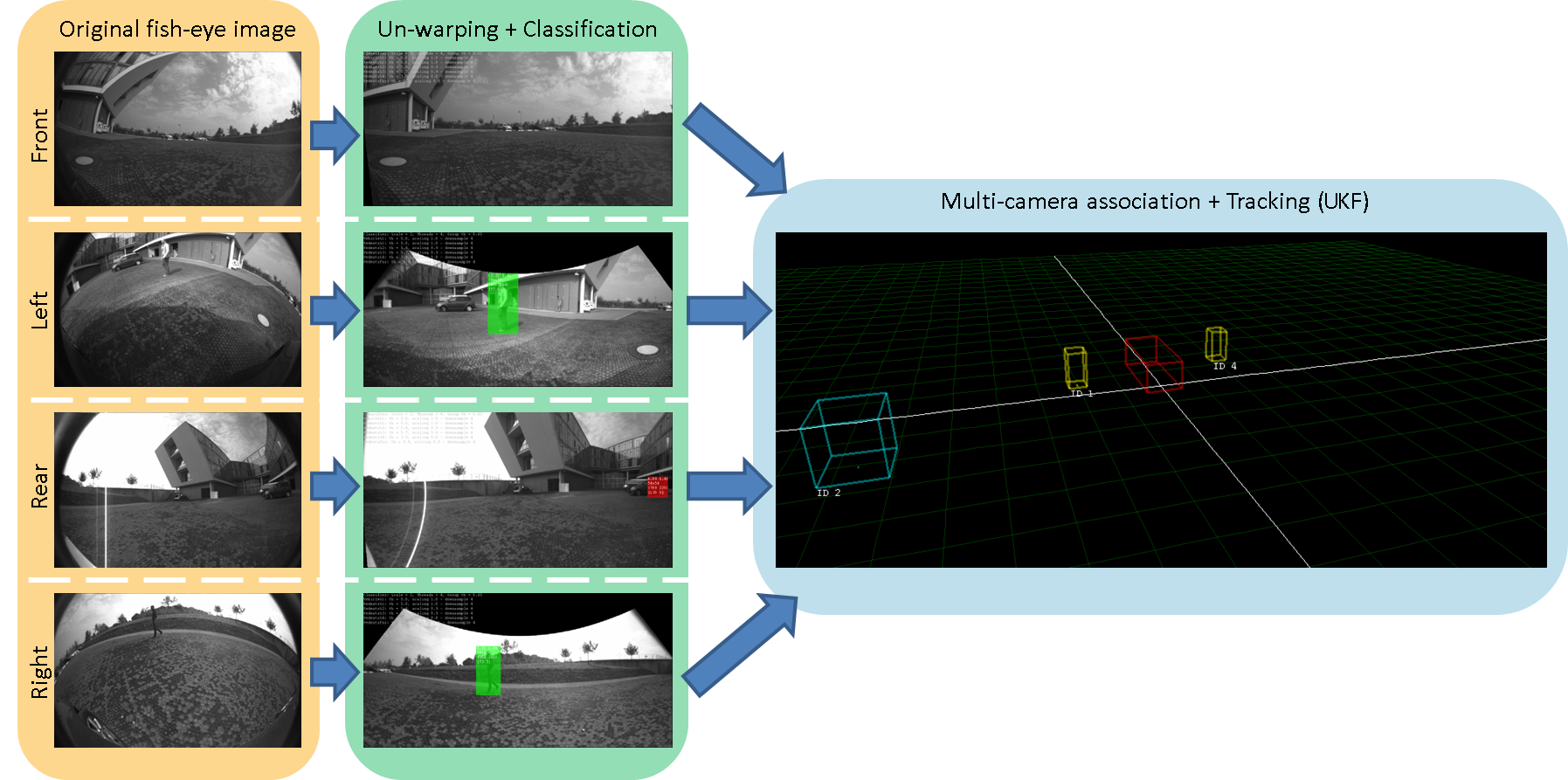
All-around view is a mandatory element for autonomous vehicles. The European V-Charge project seeks to develop an autonomous vehicle using only low-cost sensors. This paper presents a detection and tracking algorithm that covers all the area around the vehicle using 4 fisheyecameras only. The algorithm is able to detect pedestrians and vehicles and track them, using cylindrical images. This paper presents the whole pipeline, from the image un-warping to the classification and the tracking algorithms, together with some results.


@inproceedings{iv2015v-charge,
author="Massimo Bertozzi AND Luca Castangia AND Stefano Cattani AND Antonio Prioletti AND Pietro Versari",
title="{360$^\circ$ Detection and Tracking Algorithm of both Pedestrian and Vehicle using Fisheye images}",
booktitle = "Procs.~IEEE Intelligent Vehicles Symposium 2015",
year=2015,
address = "Seoul, Korea",
month=jun
}
Vehicular Communications in the V-Charge Project

April 23, 2015 in Publications, TUB, year 4

Julian Timpner, Stephan Rottmann, and Lars Wolf

2nd GI/ITG KuVS Fachgespräch Inter-Vehicle Communication (FG-IVC 2014)

Future requirements for drastic reduction of CO2 production and energy consumption will lead to significant changes in the way we see mobility in the years to come.
However, the automotive industry has identified significant barriers to the adoption of electric vehicles, including reduced driving range and greatly increased refueling times.
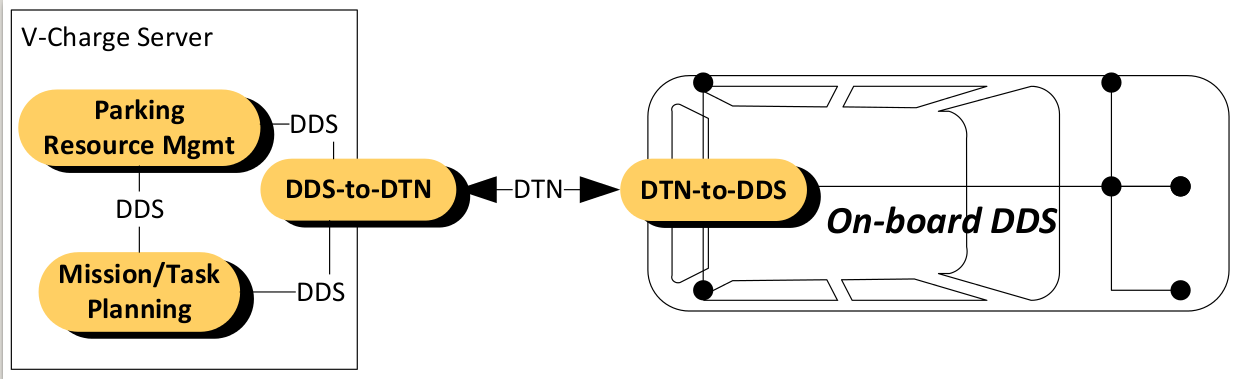
The V-Charge Project, funded by the European Commission, seeks to address these problems simultaneously by developing an electric automated car, outfitted with close-to-market sensors, which is able to automate valet parking and recharging for integration into a future transportation system.
In this paper, we describe the research challenges associated with providing a wireless V2X communication infrastructure for V-Charge-enabled parking areas.

Demo: Automated Valet Parking and Charging

April 23, 2015 in Publications, TUB, year 4

Stephan Rottmann, Julian Timpner, and Lars Wolf

IEEE Vehicular Networking Conference (VNC) 2014

A model electric vehicle performing automated valet parking and charging is demonstrated.
The vehicle’s missions are transmitted using WLAN based vehicle-to-infrastructure communications by a server back-end which has been developed in the EU FP7 project V-Charge.


@inproceedings{Rottmann:VNC:14,
address = {Paderborn, Germany},
doi = {https://dx.doi.org/10.1109/VNC.2014.7013348},
author = {Rottmann, Stephan and Timpner, Julian and Wolf, Lars C},
booktitle = {Proceedings of the IEEE Vehicular Networking Conference (VNC)},
keywords = {Automated valet parking,Demonstrator,V2I,Vehicular Communications},
month = dec,
publisher = {IEEE},
title = {{Demo: Automated Valet Parking and Charging}},
year = {2014},
pages = {207--208},
}

Breadcrumb Routing: Query-Reponse Geocast for Mobile Originators in Vehicular Networks

April 23, 2015 in Publications, TUB, year 4

Julian Timpner, Mario Wozenilek, and Lars Wolf

IEEE Vehicular Networking Conference (VNC) 2014

Vehicular ad hoc networks allow connected vehicles to exchange and share information in order to improve traffic efficiency and safety as well as to provide infotainment functions.
In order to cope with the challenging network conditions of the vehicular domain (e.g., intermittent connectivity), a disruption-tolerant networking architecture is suitable.
In contrast to push-based communications (e.g, cooperative awareness messages) used in many proposed vehicular applications, we focus on a query-response model for requesting sensor information.
Of particular interest to us is the question how vehicular queries can be efficiently routed to a destination area in such challenged environments, and, more importantly, how the response can be routed back to a moving query originator.
We therefore present BGR, a novel disruption-tolerant georouting protocol based on a trail of breadcrumbs left by the query originator.
As an overlay protocol, BGR can be used on top of different georouting mechanisms, providing an efficient means to address moving originators.
We study the influence of parameters, e.g., breadcrumb size and distance, and prove the effectiveness of the proposed solution in an extensive experimental evaluation, showing that BGR achieves significantly higher delivery rates compared to traditional geocast approaches, while avoiding up to 97% of the traffic overhead of Epidemic and PRoPHET routing.


@inproceedings{Timpner:VNC:2014,
address = {Paderborn, Germany},
author = {Timpner, Julian and Wozenilek, Mario and Wolf, Lars},
booktitle = {Proceedings of the IEEE Vehicular Networking Conference (VNC)},
keywords = {DTN,Georouting,V2V,VANET},
doi = {https://dx.doi.org/10.1109/VNC.2014.7013308},
month = dec,
publisher = {IEEE},
pages = {49--56},
title = {{Breadcrumb Routing: Query-Reponse Geocast for Mobile Originators in
Vehicular Networks}},
year = {2014},
}

Lighting-Invariant Adaptive Route Following Using ICP

January 21, 2015 in Journals, Publications, year 4

Philipp Krüsi, Bastian Bücheler, Francois Pomerleau, Ulrich Schwesinger, Roland Siegwart, and Paul Furgale

Journal of Field Robotics, 2014

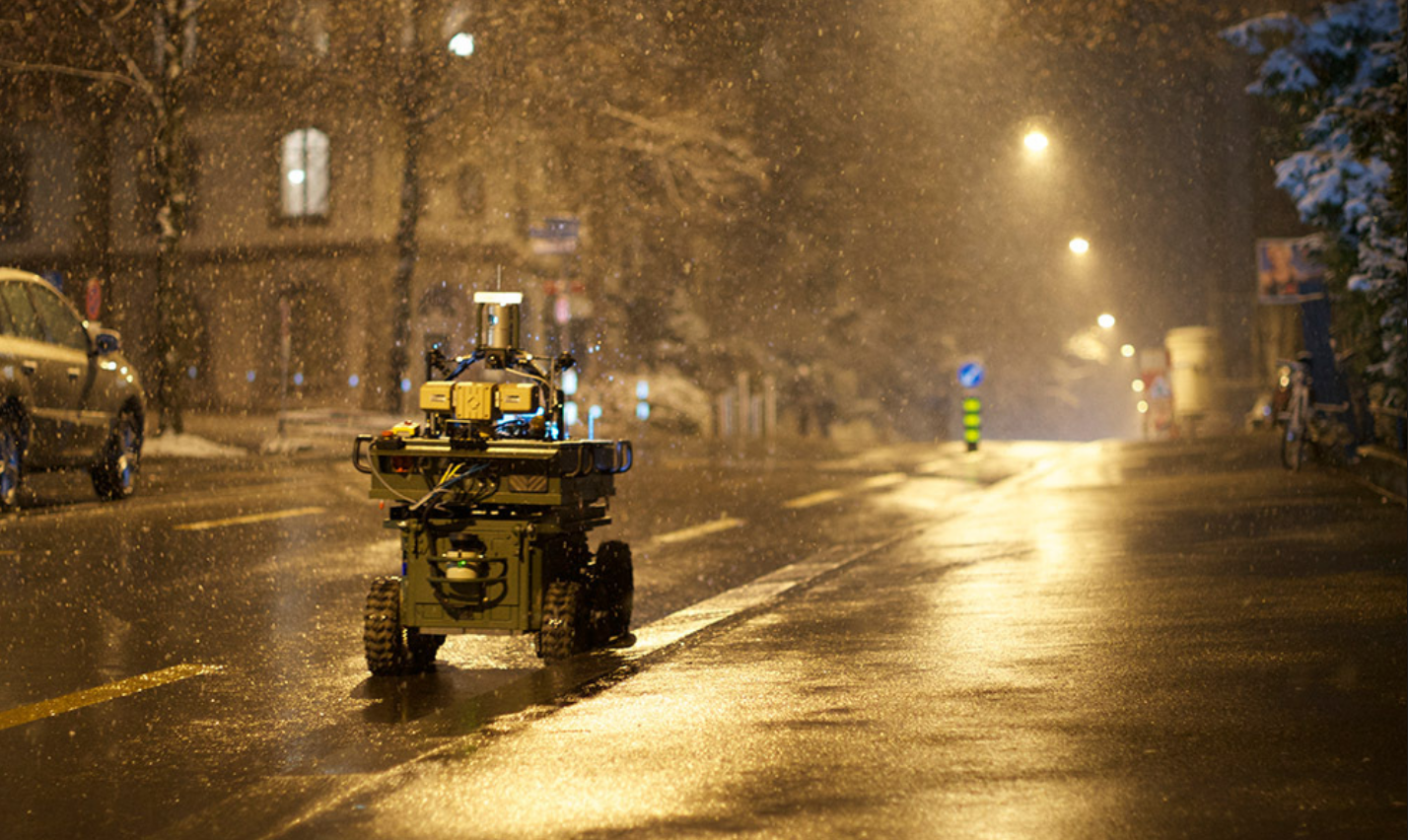
Topological/metric route following, also called teach and repeat (T&R), enables long-range autonomous navigation even without globally consistent localization. In the teach pass, the robot is driven manually and builds up a topological/metric map of the environment: a graph of metric submaps connected by relative transformations. For repeating the route autonomously, the map only needs to be locally consistent; errors on the global level due to localization drift are irrelevant. This renders T&R ideal for applications where a global positioning system may not be available, such as navigation through street canyons or forests in search and rescue, reconnaissance in underground structures, surveillance, or planetary exploration.

We present a T&R system based on iterative closest point matching (ICP) using data from a spinning three-dimensional (3D) laser scanner. Our algorithm is highly accurate, robust to dynamic scenes and extreme changes in the environment, and independent of ambient lighting. It enables autonomous navigation along a taught path in both structured and unstructured environments, including highly 3D terrain. Furthermore, our system is able to detect obstacles and avoid them by adapting its path using a local motion planner. It enables autonomous route following in non-static environments, which is not possible with classical T&R systems.

We demonstrate our algorithm’s performance in two long-range driving experiments, one in a highly dynamic urban environment, the other in unstructured, rough, 3D terrain. In these experiments our robot autonomously drove a distance of over 22 kilometers in both day and night. We analyze the localization accuracy of our system and show that it is highly precise. Moreover, we compare our ICP-based method to a state-of-the-art stereo-vision-based technique and show that our approach has a greatly increased robustness to path deviations and is less dependent on environmental conditions.


@article{kruesi_jfr14,
note = { Accepted for publication on March 31, 2014. },
journal = { Journal of Field Robotics },
year = { 2014 },
title = { Lighting-Invariant Adaptive Route Following Using ICP },
author = { Philipp Kr\"{u}si and Bastian B\"{u}cheler and Fran\c{c}ois Pomerleau and Ulrich Schwesinger and Roland Siegwart and Paul Furgale },
}

There and Back Again

January 21, 2015 in ETHZ-ASL, Publications, year 4

P. Furgale, P. Krüsi, F. Pomerleau, U. Schwesinger, F. Colas, and R. Siegwart

IEEE International Conference on Intelligent Robots and Systems (ICRA), 2014

Topological/metric route following, also called teach and repeat (T&R), enables long-range autonomous navigation even without globally consistent localization. This ren- ders T&R ideal for applications where a global positioning system may not be available, such as navigation through street canyons or forests in search and rescue, reconnaissance in underground structures, surveillance, or planetary exploration.

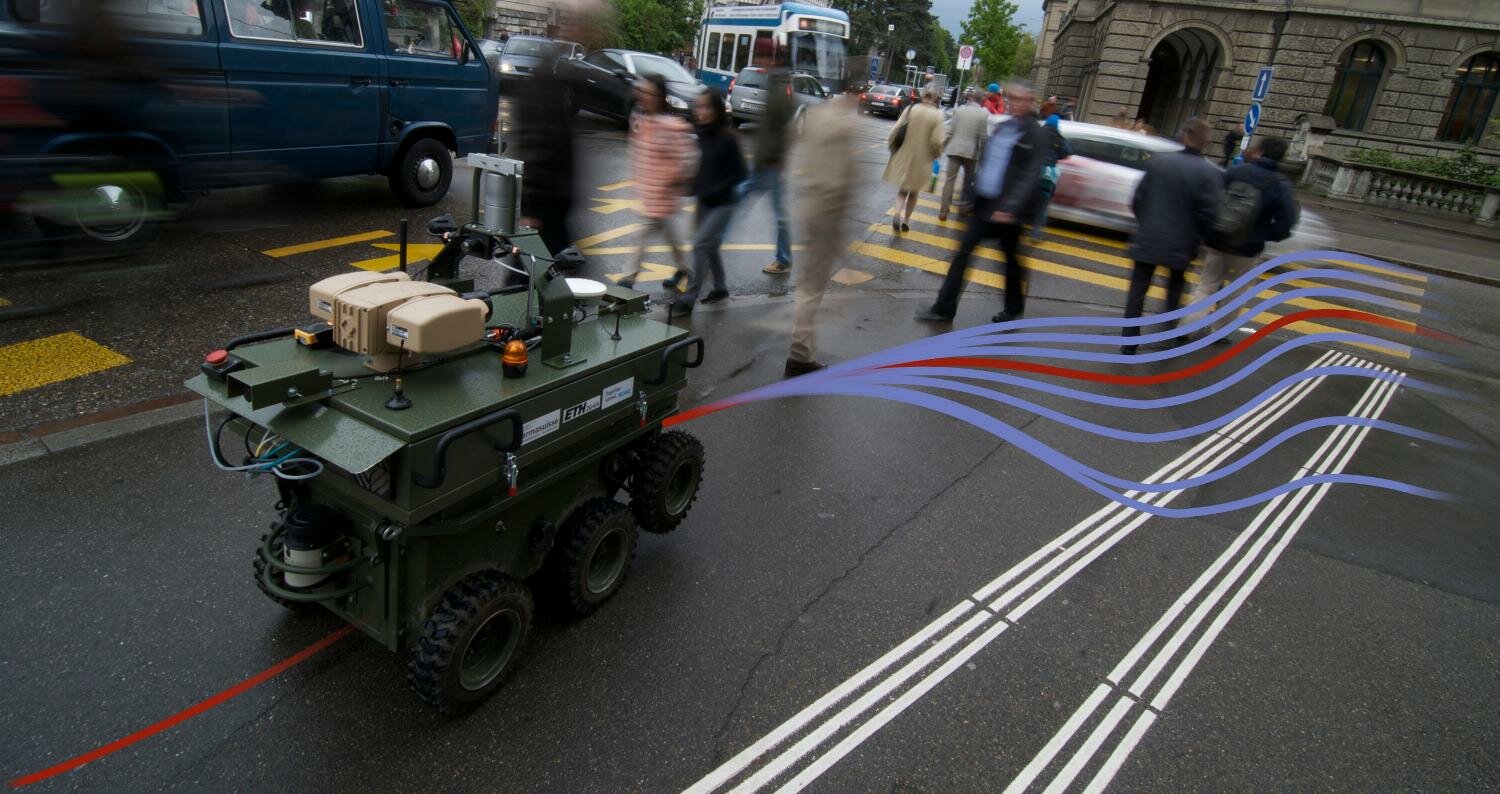
This talk will present our efforts to develop a T&R system suitable for long-term robot autonomy in highly dynamic, unstructured environments. We use the fast iterative closest point (ICP) algorithms from libpointmatcher 1 to build a T&R system based on a spinning laser range finder. The system deals with dynamic elements in two ways. First, we employ a system-compliant local motion planner to react to dynamic elements in the scene during route following. Second, the system infers the static or dynamic state of each 3D point in the environment based on repeated observations. The velocity of each dynamic point is estimated without requiring object models or explicit clustering of the points. At any time, the system is able to produce a most-likely representation of underlying static scene geometry. By storing the time history of velocities, we can infer the dominant motion patterns within the map. The result is an online mapping and localization system specifically designed to enable long-term autonomy within highly dynamic environments. We validate the approach using data collected around the campus of ETH Zurich over seven months and at an outdoor 3D test site in Thun, Switzerland

@article{furgale_workshop_icra14,
journal = {ICRA14 Workshop on Modelling, Estimation, Perception, and Control of All Terrain Mobile Robots},
year = 2014,
month = june,
title = { There and Back Again—Dealing with highly-dynamic scenes and long-term change during topological/metric route following },
author = { Furgale, P and Philipp, K and and Pomerleau, F and Schwesinger, U and Colas, F and Roland Siegwart },
address = { Hong Kong, China },
}

Vehicle detection for autonomous parking using a Soft-Cascade AdaBoost classifier

September 1, 2014 in Parma-Vislab, Publications, year 4

Alberto Broggi, Elena Cardarelli, Stefano Cattani, Paolo Medici, and Mario Sabbatelli

IEEE Intelligent Vehicles Symposium 2014

This paper presents a monocular algorithm for front and rear vehicle detection, developed as part of the FP7 V-Charge project’s perception system. The system is made of an AdaBoost classifier with Haar Features Decision Stump. It processes several virtual perspective images, obtained by un-warping 4 monocular fish-eye cameras mounted all-around an autonomous electric car. The target scenario is the automated valet parking, but the presented technique fits well in any general urban and highway environment. A great attention has been given to optimize the computational performance. The accuracy in the detection and a low computation costs are provided by combining a multiscale detection scheme with a Soft-Cascade classifier design. The algorithm runs in real time on the project’s hardware platform.
The system has been tested on a validation set, compared with several AdaBoost schemes, and the corresponding results and statistics are also reported.

@inproceedings{iv2014vcharge,
author="Alberto Broggi AND Elena Cardarelli AND Stefano Cattani AND Paolo Medici AND Mario Sabbatelli",
title="{Vehicle detection for autonomous parking using a Soft-Cascade AdaBoost classifier}",
booktitle = "Procs.~IEEE Intelligent Vehicles Symposium 2014",
pages="912--917",
year=2014,
address = "Dearbon, MI, USA",
month=jun
}
Unified Temporal and Spatial Calibration for Multi-Sensor Systems

July 17, 2014 in ETHZ-ASL, Publications, year 4

Paul Furgale, Joern Rehder and Roland Siegwart

IEEE/RSJ International Conference on Intelligent Robots and Systems (IROS)

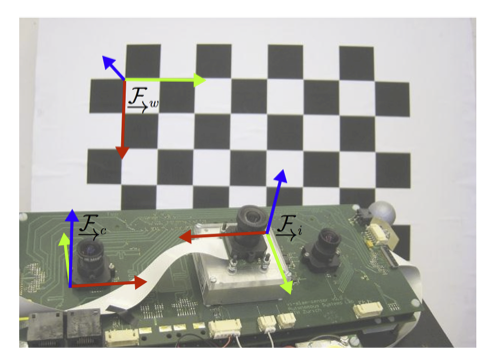
In order to increase accuracy and robustness in state estimation for robotics, a growing number of applications rely on data from multiple complementary sensors. For the best performance in sensor fusion, these different sensors must be spatially and temporally registered with respect to each other. To this end, a number of approaches have been developed to estimate these system parameters in a two stage process, first estimating the time offset and subsequently solving for the spatial transformation between sensors. In this work, we present on a novel framework for jointly estimating the temporal offset between measurements of different sensors and their spatial displacements with respect to each other. The approach is enabled by continuous-time batch estimation and extends previous work by seamlessly incorpo- rating time offsets within the rigorous theoretical framework of maximum likelihood estimation. Experimental results for a camera to inertial measurement unit (IMU) calibration prove the ability of this framework to accurately estimate time offsets up to a fraction of the smallest measurement period.


@inproceedings{furgale_iros13,
doi = { 10.1109/IROS.2013.6696514 },
year = { 2013 },
url = { bib/furgale_iros13.pdf },
title = { Unified Temporal and Spatial Calibration for Multi-Sensor Systems },
pages = { 1280--1286 },
month = { 3--7 November },
booktitle = { Proceedings of the IEEE/RSJ International Conference on Intelligent Robots and Systems (IROS) },
author = { Paul Furgale and Joern Rehder and Roland Siegwart },
address = { Tokyo, Japan },
}

OpenGV: A Unified and Generalized Approach to Real-Time Calibrated Geometric Vision

July 17, 2014 in ETHZ-ASL, Publications, year 4

Laurent Kneip and Paul Timothy Furgale

IEEE International Conference on Robotics and Automation (ICRA) 2014

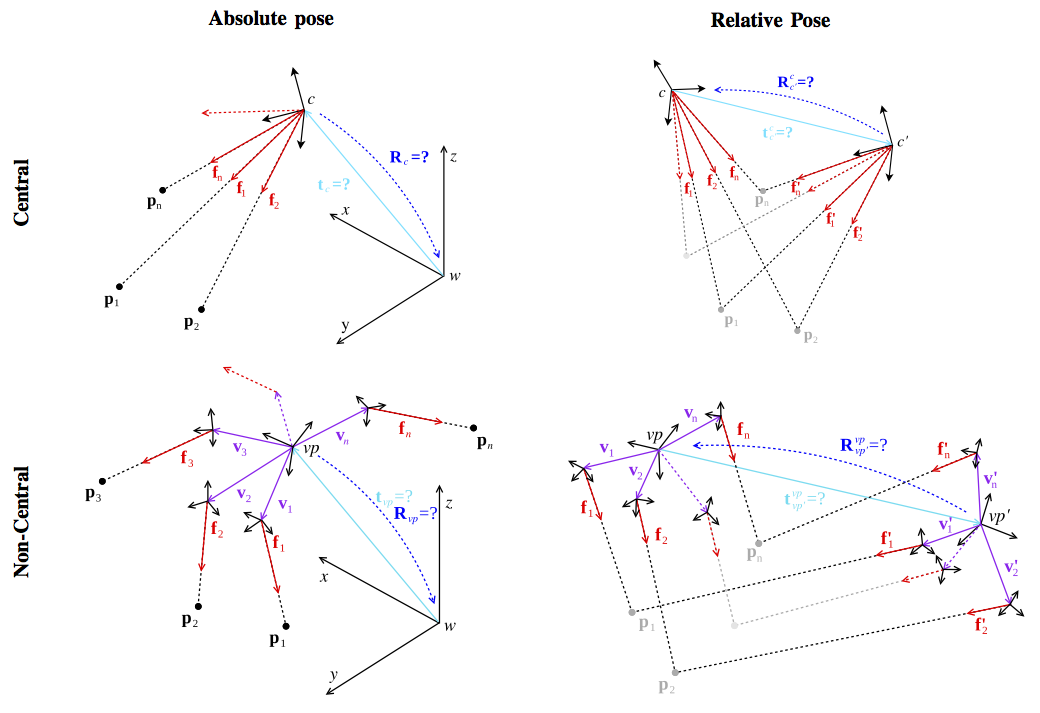
OpenGV is a new C++ library for calibrated real- time 3D geometric vision. It unifies both central and non-central absolute and relative camera pose computation algorithms within a single library. Each problem type comes with minimal and non-minimal closed-form solvers, as well as non-linear iterative optimization and robust sample consensus methods. OpenGV therefore contains an unprecedented level of com- pleteness with regard to calibrated geometric vision algorithms, and it is the first library with a dedicated focus on a unified real-time usage of non-central multi-camera systems, which are increasingly popular in robotics and in the automotive industry. This paper introduces OpenGV¿s flexible interface and abstraction for multi-camera systems, and outlines the performance of all contained algorithms. It is our hope that the introduction of this open-source platform will motivate people to use it and potentially also include more algorithms, which would further contribute to the general accessibility of geometric vision algorithms, and build a common playground for the fair comparison of different solutions.


@inproceedings{kneip_icra14,
year = { 2014 },
codeurl = { https://laurentkneip.github.io/opengv/ },
note = { (\href{https://laurentkneip.github.io/opengv/}{code}) },
pages = { 1--8 },
url = { bib/kneip_icra14.pdf },
title = { OpenGV: A Unified and Generalized Approach to Real-Time
Calibrated Geometric Vision },
booktitle = { Proceedings of the IEEE International Conference on
Robotics and Automation (ICRA) },
author = { Laurent Kneip and Paul Timothy Furgale },
month = { May 3 -- June 7 },
address = { Hong Kong, China },
}

Associating Uncertainty with Three-Dimensional Poses for use in Estimation Problems

July 17, 2014 in ETHZ-ASL, Journals, Publications, year 4

Barfoot, Furgale

Robotics, IEEE Transactions on, 30(3), pp. 679-693

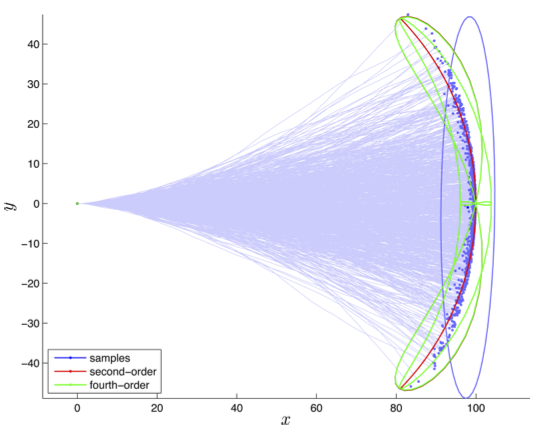
In this paper, we provide specific and practical approaches to associate uncertainty with 4 ?? 4 transformation matrices, which is a common representation for pose variables in 3-D space. We show constraint-sensitive means of perturbing transformation matrices using their associated exponential-map generators and demonstrate these tools on three simple-yet-important estimation problems: 1) propagating uncertainty through a compound pose change, 2) fusing multiple measurements of a pose(e.g., for use in pose-graph relaxation), and 3) propagating uncertainty on poses (and landmarks) through a nonlinear camera model. The contribution of the paper is the presentation of the theoretical tools, which can be applied in the analysis of many problems involving 3-D pose and point variables.


@article{barfoot_tro14,
year = { 2014 },
title = { Associating Uncertainty with Three-Dimensional Poses for
use in Estimation Problems },
codeurl = { https://asrl.utias.utoronto.ca/code/barfoot_tro14.zip },
journal = { Robotics, IEEE Transactions on },
author = { Barfoot and Furgale },
pages = { 679-693 },
number = { 3 },
volume = { 30 },
month = { jun },
doi = { 10.1109/TRO.2014.2298059 },
}