 by
by Using Multi-Camera Systems in Robotics: Efficient Solutions to the NPnP Problem
March 15, 2013 in ETHZ-ASL, Publications, year 2 by admin
Laurent Kneip, Paul Timothy Furgale, Roland Siegwart
2013 IEEE International Conference on Robotics and Automation (ICRA)
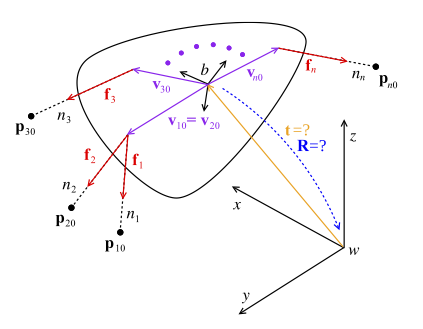 This paper introduces two novel solutions to the generalized-camera exterior orientation problem, which has a vast number of potential applications in robotics: (i) a minimal solution requiring only three point correspondences, and (ii) gPnP, an efficient, non-iterative n-point solution with linear complexity in the number of points. Already existing minimal solutions require exhaustive algebraic derivations. In contrast, our novel minimal solution is solved in a straightforward manner using the Gro ̈bner basis method. Existing n-point solutions are mostly based on iterative optimization schemes. Our n-point solution is non-iterative and outperforms existing algorithms in terms of computational efficiency. Our results present an evaluation against state-of-the-art single-camera algorithms, and a comparison of different multi-camera setups. It demonstrates the superior noise resilience achieved when using multi-camera configurations, and the efficiency of our algorithms. As a further contribution, we illustrate a possible robotic use-case of our non-perspective orientation computation algorithms by presenting visual odometry results on real data with a non-overlapping multi-camera configuration, including a comparison to a loosely coupled alternative.
                      @inproceedings{kneip_icra13,

                      Address = {Karlsruhe, Germany},

                      Author = {Laurent Kneip and Paul Timothy Furgale and Roland Siegwart},

                      Booktitle = {Proceedings of the IEEE International Conference on Robotics and Automation (ICRA), to appear.},

                      Month = {6-10 May},

                      Title = {Using Multi-Camera Systems in Robotics: Efficient Solutions to the NPnP Problem},

                      Year = {2013}

                      }


