by admin

Relative Pose Estimation for a Multi-Camera System with Known Vertical Direction

June 12, 2014 in ETHZ-CVG, Publications, year 3 by admin

Gim Hee Lee, Marc Pollefeys, and Friedrich Fraundorfer

2014 IEEE International Conference on Computer Vision and Pattern Recognition (CVPR)
In this paper, we present our minimal 4-point and linear 8-point algorithms to estimate the relative pose of a multi-camera system with known vertical directions, i.e. known absolute roll and pitch angles. We solve the minimal 4-point algorithm with the hidden variable resultant method and show that it leads to an 8-degree univariate polynomial that gives up to 8 real solutions. We identify a degenerated case from the linear 8-point algorithm when it is solved with the standard Singular Value Decomposition (SVD) method and adopt a simple alternative solution which is easy to implement. We show that our proposed algorithms can be efficiently used within RANSAC for robust estimation. We evaluate the accuracy of our proposed algorithms by comparisons with various existing algorithms for the multi-camera system on simulations and show the feasibility of our proposed algorithms with results from multiple real-world datasets.


@inproceedings{leeCVPR14,
author = {Gim Hee Lee and
Marc Pollefeys and
Friedrich Fraundorfer},
title = {Relative Pose Estimation for a Multi-Camera System with Known Vertical Direction},
booktitle = {IEEE International Conference on Computer Vision and Pattern Recognition (CVPR)},
year = {2014},
pages = {}
}
by admin

Class Specific 3D Object Shape Priors Using Surface Normals

June 12, 2014 in ETHZ-CVG, Publications, year 3 by admin

Christian Haene, Nikolay Savinov, and Marc Pollefeys

2014 IEEE International Conference on Computer Vision and Pattern Recognition (CVPR)

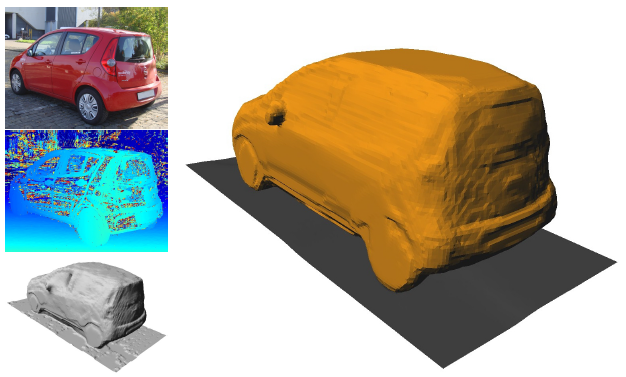
Dense 3D reconstruction of real world objects containing textureless, reflective and specular parts is a challenging task. Using general smoothness priors such as surface area regularization can lead to defects in the form of disconnected parts or unwanted indentations. We argue that this problem can be solved by exploiting the object class specific local surface orientations, e.g. a car is always close to horizontal in the roof area. Therefore, we formulate an object class specific shape prior in the form of spatially varying anisotropic smoothness terms. The parameters of the shape prior are extracted from training data. We detail how our shape prior formulation directly fits into recently proposed volumetric multi-label reconstruction approaches. This allows a segmentation between the object and its supporting ground. In our experimental evaluation we show reconstructions using our trained shape prior on several challenging datasets.


@inproceedings{haeneCVPR14,
author = {Christian Haene and
Nikolay Savinov and
Marc Pollefeys},
title = {Class Specific 3D Object Shape Priors Using Surface Normals},
booktitle = {IEEE International Conference on Computer Vision and Pattern Recognition (CVPR)},
year = {2014},
pages = {}
}
by admin

Unsupervised Learning of Threshold for Geometric Verification in Visual-Based Loop-Closure

June 12, 2014 in ETHZ-CVG, Publications, year 3 by admin

Gim Hee Lee, and Marc Pollefeys

2014 IEEE International Conference on Robotics and Automation (ICRA)

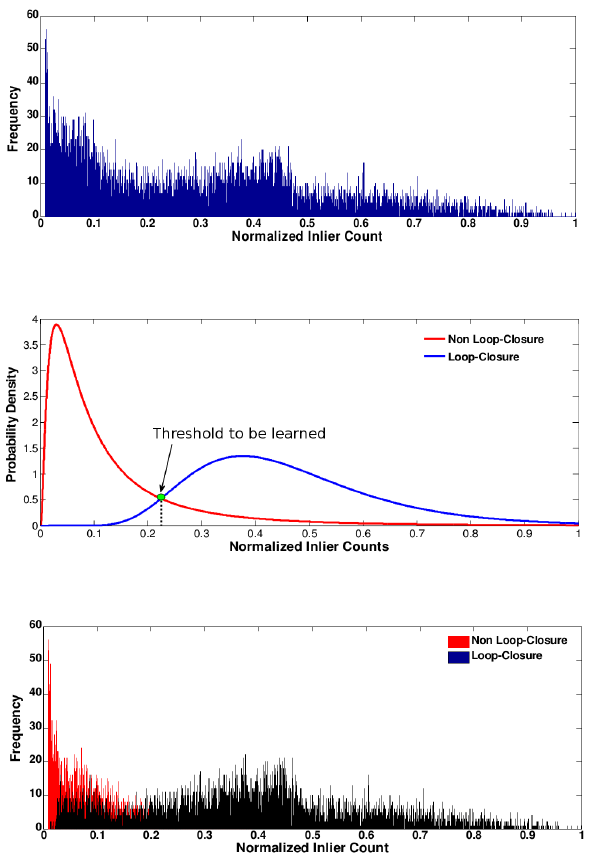
A potential loop-closure image pair passes the geometric verification test if the number of inliers from the computation of the geometric constraint with RANSAC exceed a pre-defined threshold. The choice of the threshold is critical to the success of identifying the correct loop-closure image pairs. However, the value for this threshold often varies for different datasets and is chosen empirically. In this paper, we propose an unsupervised method that learns the threshold for geometric verification directly from the observed inlier counts of all the potential loop-closure image pairs. We model the distributions of the inlier counts from all the potential loop-closure image pairs with a two components Log-Normal mixture model – one component represents the state of non loop-closure and the other represents the state of loop-closure, and learn the parameters with the Expectation-Maximization algorithm. The intersection of the Log-Normal mixture distributions is the optimal threshold for geometric verification, i.e. the threshold that gives the minimum false positive and negative loop-closures. Our algorithm degenerates when there are too few or no loop-closures and we propose the ^_chi-squared test to detect this degeneracy. We verify our proposed method with several large-scale datasets collected from both the multi-camera setup and stereo camera.


@inproceedings{leeICRA14,
author = {Gim Hee Lee and
Marc Pollefeys},
title = {Unsupervised Learning of Threshold for Geometric Verification in Visual-Based Loop-Closure},
booktitle = {IEEE International Conference on Robotics and Automation (ICRA)},
year = {2014},
pages = {}
}
by admin

Infrastructure-Based Calibration of a Multi-Camera Rig

June 12, 2014 in ETHZ-ASL, ETHZ-CVG, Publications, year 3 by admin

Lionel Heng, Mathias Buerki, Gim Hee Lee, Paul Furgale, Roland Siegwart, and Marc Pollefeys

2014 IEEE International Conference on Robotics and Automation (ICRA)

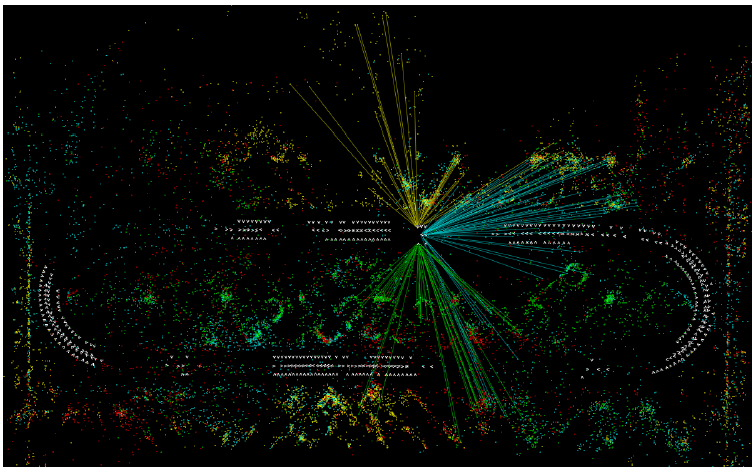
The online recalibration of multi-sensor systems is a fundamental problem that must be solved before complex automated systems are deployed in situations such as automated driving. In such situations, accurate knowledge of calibration parameters is critical for the safe operation of automated systems. However, most existing calibration methods for multi-sensor systems are computationally expensive, use installations of known fiducial patterns, and require expert supervision. We propose an alternative approach called infrastructure-based calibration that is efficient, requires no modification of the infrastructure, and is completely unsupervised. In a survey phase, a computationally expensive simultaneous localization and mapping (SLAM) method is used to build a highly accurate map of a calibration area. Once the map is built, many other vehicles are able to use it for calibration as if it were a known fiducial pattern.

We demonstrate the effectiveness of this method to calibrate the extrinsic parameters of a multi-camera system. The method does not assume that the cameras have an overlapping field of view and it does not require an initial guess. As the camera rig moves through the previously mapped area, we match features between each set of synchronized camera images and the map. Subsequently, we find the camera poses and inlier 2D-3D correspondences. From the camera poses, we obtain an initial estimate of the camera extrinsics and rig poses, and optimize these extrinsics and rig poses via non-linear refinement. The calibration code is publicly available as a standalone C++ package.


@inproceedings{hengICRA14,
author = {Lionel Heng and
Mathias Buerki and
Gim Hee Lee and
Paul Furgale and
Roland Siegwart and
Marc Pollefeys},
title = {Infrastructure-Based Calibration of a Multi-Camera Rig},
booktitle = {IEEE International Conference on Robotics and Automation (ICRA)},
year = {2014},
pages = {}
}
by admin

Minimal Solutions for Pose Estimation of a Multi-Camera System

February 3, 2014 in ETHZ-CVG, Publications, year 3 by admin

Gim Hee Lee, Bo Li, Marc Pollefeys, and Friedrich Fraundorfer

International Symposium on Robotics Research (ISRR) 2013

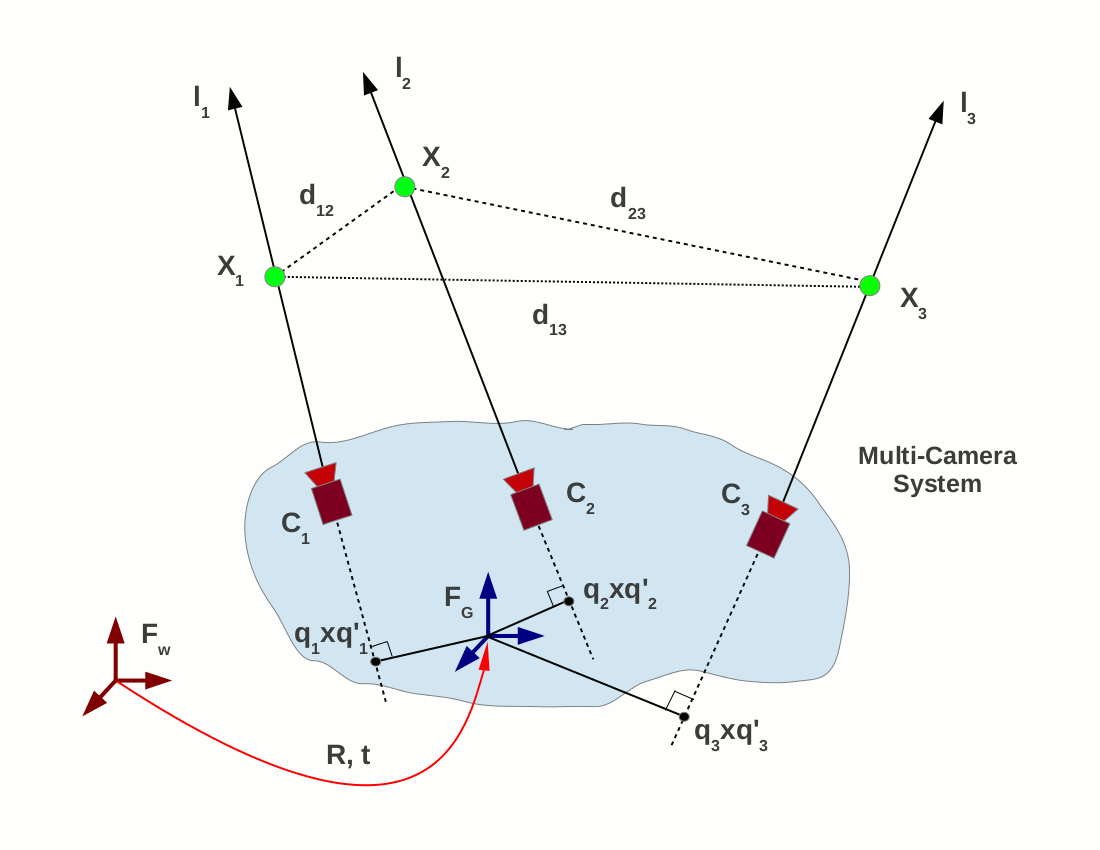
In this paper, we propose a novel formulation to solve the pose estimation problem of a calibrated multi-camera system.
The non-central rays that pass through the 3D world points and multi-camera system are elegantly represented as Pluecker lines. This allows us to solve for the depth of the points along the Pluecker lines with a minimal set of 3-point correspondences.
We show that the minimal solution for the depth of the points along the Pluecker lines is an 8 degree polynomial that gives up to 8 real solutions.
The coordinates of the 3D world points in the multi-camera frame are computed from the known depths. Consequently, the pose of the multi-camera system, i.e. the rigid transformation between the world and multi-camera frames can be obtained from absolute orientation.
We also derive a closed-form minimal solution for the absolute orientation. This removes the need for the computationally expensive Singular Value Decompositions (SVD) during the evaluations of the possible solutions for the depths. We identify the correct solution and do robust estimation with RANSAC.
Finally, the solution is further refined by including all the inlier correspondences in a non-linear refinement step. We verify our approach by showing comparisons with other existing approaches and results from large-scale real-world datasets.


@inproceedings{leeISRR13,
author = {Gim Hee Lee, Bo Li, Marc Pollefeys, and Friedrich Fraundorfer},
title = {Minimal Solutions for Pose Estimation of a Multi-Camera System},
booktitle = {International Symposium on Robotics Research (ISRR) 2013},
year = {2013}
}

by admin

Design and Evaluation of Charging Station Scheduling Strategies for Electric Vehicles

January 21, 2014 in Journals, Publications, TUB, year 3 by admin

Julian Timpner and Lars C. Wolf

IEEE Transactions on Intelligent Transportation Systems (Journal)

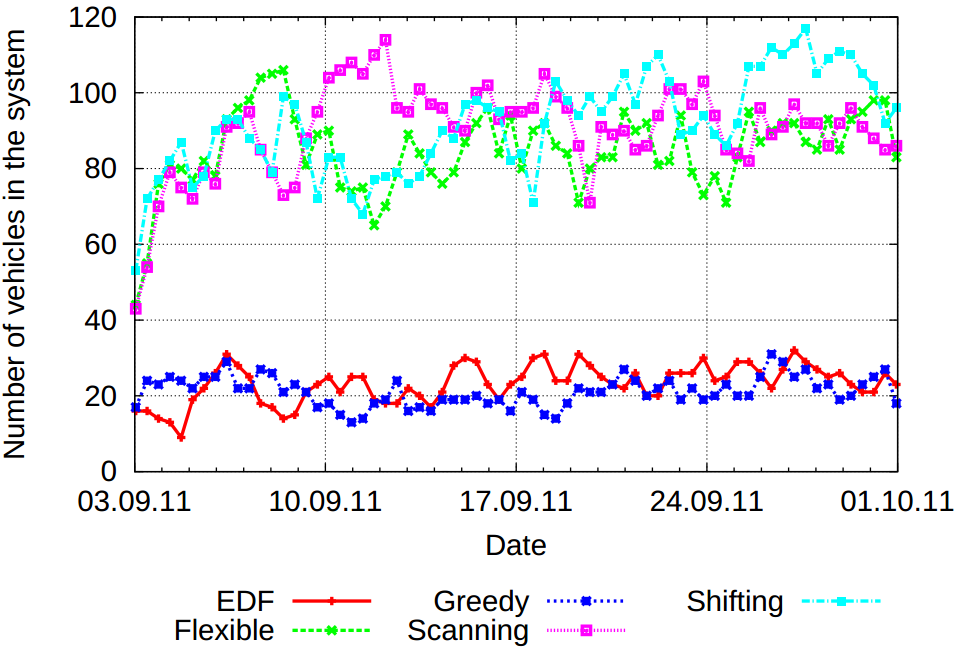
Electric vehicles (EVs) still have relatively long and frequent charging cycles. Moreover, charging resources are typically limited and must therefore be used efficiently. The V-Charge project has the vision to provide a solution by combining autonomous valet parking with e-mobility, introducing improved parking and charging comfort. V-Charge proposes a solution for charging autonomous EVs in parking places and efficiently using scarce charging resources, thus simplifying the life of the customer and increasing the feasibility of EVs. For the management of parking lots and charging resources, V-Charge provides a server back end and a communication infrastructure. In this paper, we present our design of scheduling concepts for a coordinated charging strategy that is implemented by this back end. Through intensive simulations, we show that the V-Charge server is able to efficiently handle realistic parking volume and performs well in fulfilling customer requirements, e.g., energy demand for the next driving tasks. Moreover, we evaluate the suitability of various scheduling strategies in different usage scenarios. For the simulation setup, real-world parking statistics obtained from Hamburg Airport and the City of Braunschweig, Germany, are used.


@article{Timpner:TITS:2013,
author = {Timpner, Julian and Wolf, Lars},
doi = {10.1109/TITS.2013.2283805},
journal = {IEEE Transactions on Intelligent Transportation Systems},
publisher = {IEEE},
title = {{Design and Evaluation of Charging Station Scheduling Strategies for Electric Vehicles}},
year = {2013},
month=nov,
volume=PP,
number=99,
issn={1524-9050},
URL={https://ieeexplore.ieee.org/xpl/articleDetails.jsp?arnumber=6651804},
}

by admin

Estimation of Vehicular Connectivity in Autonomous Parking Scenarios

January 21, 2014 in Journals, Publications, TUB, year 3 by admin

Tobias Pögel, Julian Timpner, Stephan Rottmann and Lars C. Wolf

PIK – Praxis der Informationsverarbeitung und Kommunikation (Journal)

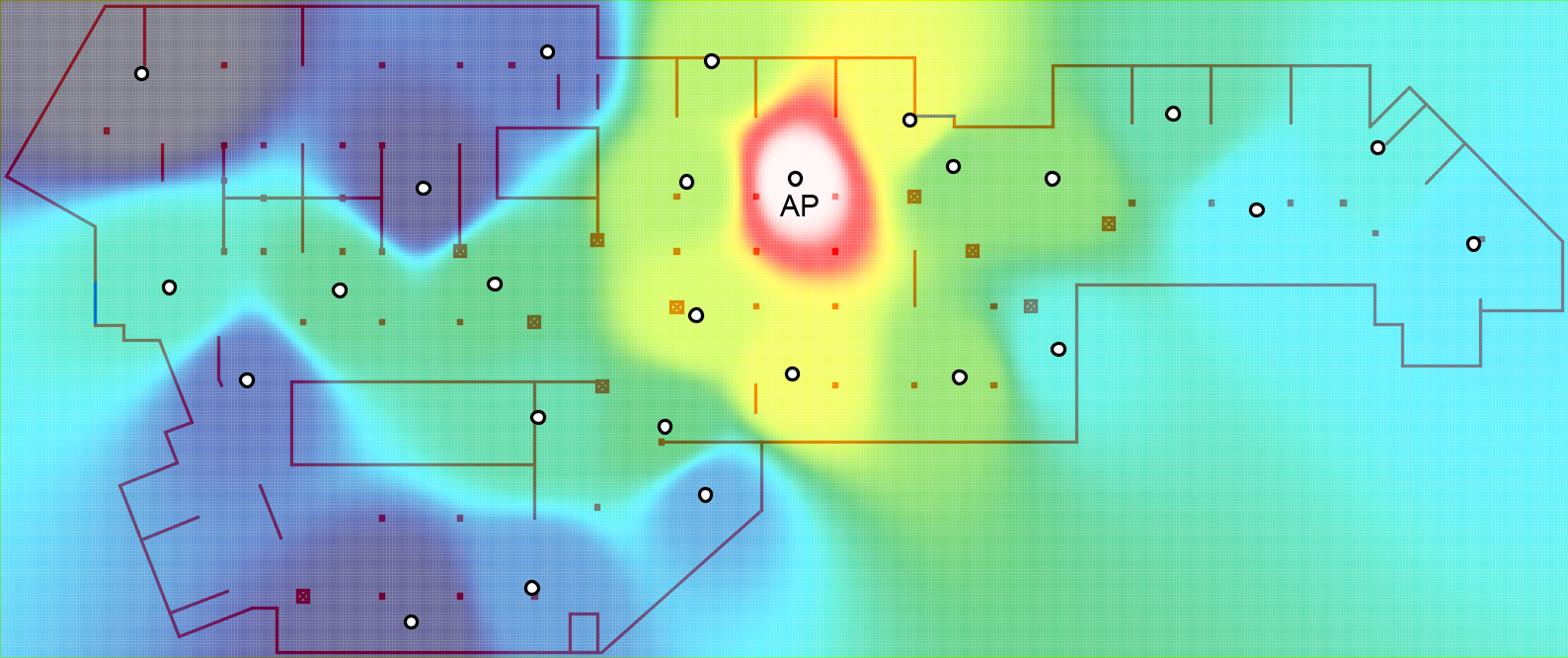
In this paper different parking scenarios for autonomous vehicles are considered. For control and monitoring purposes reliable Wi–Fi-based communication between the vehicles and a back-end is needed. It must be ensured that potential QoS requirements of different applications are met and that vehicles do not hit so-called “white spots” without any network connectivity. The network properties are represented and estimated by a Connectivity Map. For this purpose, network and measurement data are continuously collected so that other vehicles can be provided with the newly gained knowledge, which allows the planning of the proposed scenarios. This paper shows potential QoS requirements and discusses the necessary steps for the realization of such a Connectivity Map.
In addition to the automated continuous collection of relevant network parameters as a byproduct of vehicular communications, the mapping of the scenarios in terms of floor plans with additional meta-information as well as the representation of connectivity properties are shown.
We outline our vision for using the developed Connectivity Map for advanced parking management decisions.


@ARTICLE{Poegel:PIK:2013,
AUTHOR={Tobias {P{\"o}gel} and Julian Timpner and Stephan Rottmann and Lars C Wolf},
TITLE="Estimation of Vehicular Connectivity in Autonomous Parking Scenarios",
JOURNAL="PIK - Praxis der Informationsverarbeitung und Kommunikation",
PAGES={243-248},
VOLUME=36,
NUMBER=4,
DAYS=1,
MONTH=dec,
YEAR=2013,
URL={https://www.degruyter.com/view/j/piko-2013-36-issue-4/pik-2013-0026/pik-2013-0026.xml},
}

by admin

Secure Smartphone-based Registration and Key Deployment for Vehicle-to-Cloud Communications

November 28, 2013 in Publications, TUB, year 3 by admin

Julian Timpner, Domink Schürmann, and Lars Wolf

ACM Workshop on Security, Privacy and Dependability for Cyber Vehicles (CyCAR ’13)

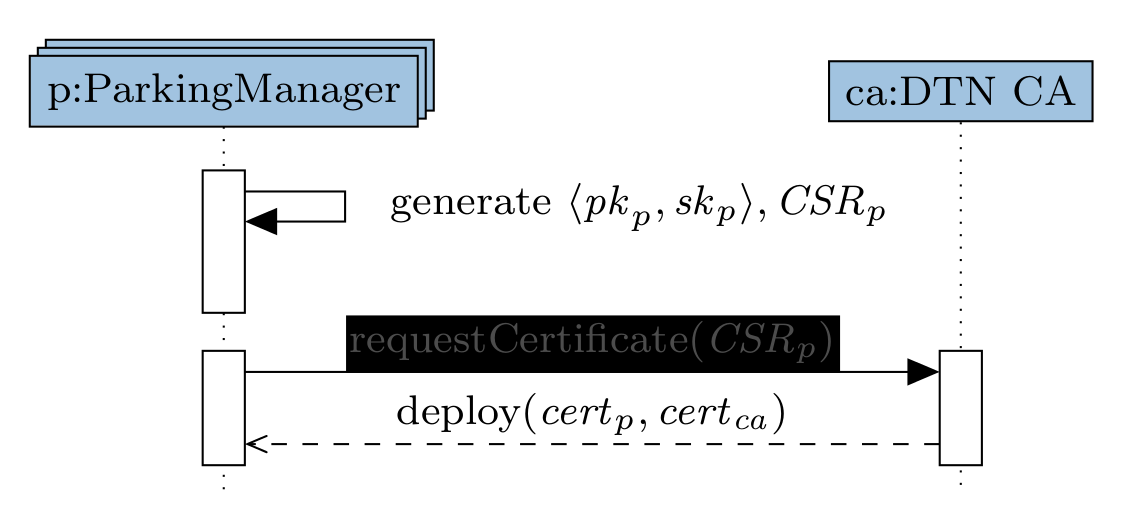
Intelligent Transportation Systems that rely on Vehicle-to- Cloud communications are emerging. Of particular inter- est to us is the question how drivers can securely register their vehicle with cloud services and deploy keys for secur- ing vehicular communications. We therefore present a secure smartphone-based registration and key deployment process for these applications. We combine an adapted OAuth flow for Smartphone-to-Cloud communications with a novel key deployment mechanism for Public Key Infrastructures in ve- hicular networks. The primary contributions of the proposed key deployment process are a high degree of independence from central authorities and feasible security audits due to an open protocol design. As an instance of future Intelligent Transportation System applications that facilitate Vehicle- to-Cloud communications, we utilize the V-Charge project as a running example to discuss potential attack scenarios and their mitigations.


@inproceedings{Timpner:CyCAR:2013,
author = {Timpner, Julian and Sch\"{u}rmann, Dominik and Wolf, Lars},
title = {{Secure Smartphone-based Registration and Key Deployment for
Vehicle-to-Cloud Communications}},
booktitle = {Proceedings of the ACM Workshop on Security, Privacy and
Dependability for Cyber Vehicles (CyCAR '13)},
month = nov,
doi = {10.1145/2517968.2517970},
isbn = {978-1-4503-2487-8},
year = {2013},
pages = {31--36},
address = {Berlin, Germany},
publisher = {ACM Press}
}

by admin

Evaluation of Fisheye-Camera Based Visual Multi-Session Localization in a Real-World Scenario

September 20, 2013 in ETHZ-ASL, Publications, VW, year 3 by admin

Peter Muehlfellner, Paul Furgale, Wojciech Derendarz, Roland Philippsen

IEEE Intelligent Vehicles Symposium (IVS) 2013

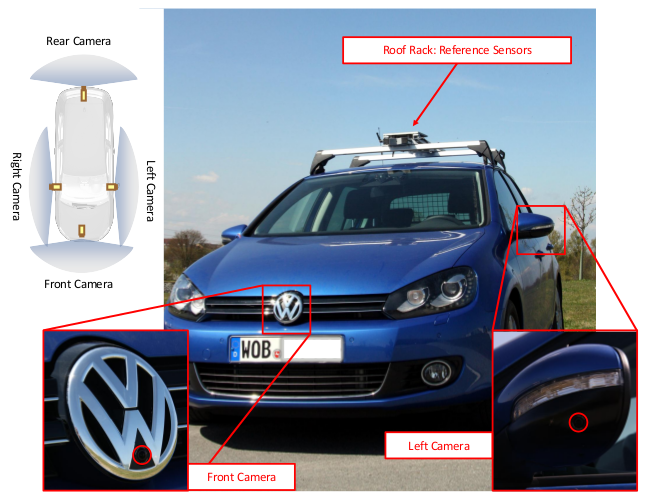
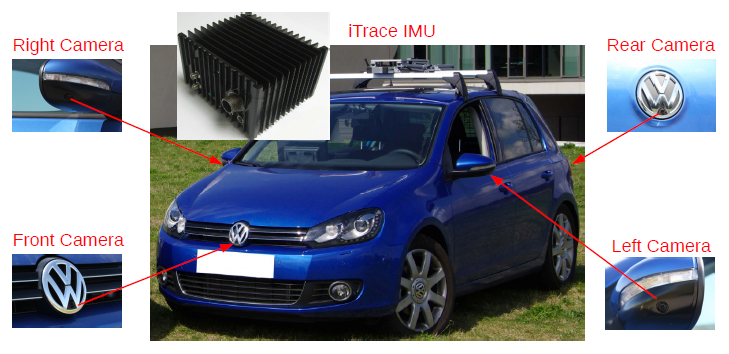
The V-Charge Golf, showing its integrated sensors and the very subtle differences to a regular “consumer car”.

The European V-Charge project seeks to develop fully automated valet parking and charging of electric vehicles using only low-cost sensors. One of the challenges is to implement robust visual localization using only cameras and stock vehicle sensors. We integratedfour monocular, wide-angle, fisheye cameras on a consumer car and implemented a mapping and localization pipeline. Visual features and odometry are combined to build and localize against a keyframe-based three dimensional map. We report results for the first stage of the project, based on two months worth of data acquired under varying conditions, with the objective of localizing against a map created offline.


@inproceedings{fisheye_iv13,
Address = {Gold Coast, Australia},
Author = {Peter Muehlfellner AND Paul Furgale AND Wojciech Derendarz AND Roland Philippsen},
Booktitle = {IEEE Intelligent Vehicles Symposium (IV)},
Month = jun,
Pages = {57--62},
Title = {{Evaluation of Fisheye-Camera Based Visual Multi-Session Localization in a Real-World Scenario}},
Year = {2013}
}

Article full text

by admin

Reciprocal Collision Avoidance With Motion Continuity Constraints

September 20, 2013 in ETHZ-ASL, Journals, Publications, year 3 by admin

Martin Rufli, Javier Alonso-Mora, Roland Siegwart

IEEE Transactions on Robotics (T-RO)

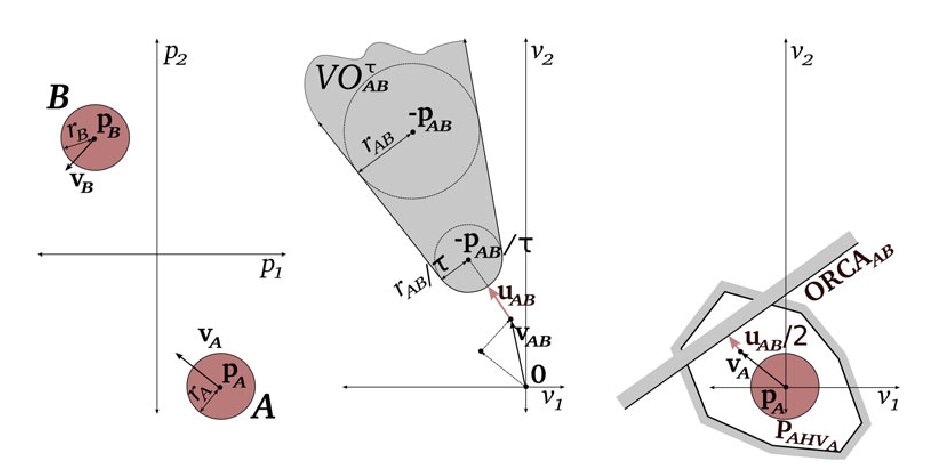
This paper addresses decentralized motion planning among a homogeneous set of feedback-controlled, decision-making agents. It introduces the continuous control obstacle (C^n-CO), which describes the set of C^n-continuous control sequences (and thus trajectories) that lead to a collision between interacting agents. By selecting a feasible trajectory from C^n-CO’s complement, a collision-free motion is obtained. The approach represents an extension to the reciprocal velocity obstacle (RVO, ORCA) collision-avoidance methods so that trajectory segments verify C^n continuity rather than piecewise linearity. This allows the large class of robots capable of tracking C^n-continuous trajectories to employ it for partial motion planning directly—rather than as a mere tool for collision checking. This paper further establishes that both the original velocity obstacle method and several of its recently developed reciprocal extensions (which treat specific robot physiologies only) correspond to particular instances of C^n-CO. In addition to the described extension in trajectory continuity, C^n-CO thus represents a unification of existing RVO theory. Finally, the presented method is validated in simulation—and a parameter study reveals under which environmental and control conditions C^n-CO with n>0 admits significantly improved navigation performance compared with inflated approaches based on ORCA.


@article{rufli_TRO13
author = {M Rufli and J Alonso-Mora and R Siegwart},
title = {Reciprocal Collision Avoidance With Motion Continuity Constraints},
journal = {IEEE Transactions on Robotics},
volume = {29},
number = {4},
year = {2013},
pages = {1-14}
}