 by
by Reciprocal Collision Avoidance With Motion Continuity Constraints
September 20, 2013 in ETHZ-ASL, Journals, Publications, year 3 by admin
Martin Rufli, Javier Alonso-Mora, Roland Siegwart
IEEE Transactions on Robotics (T-RO)
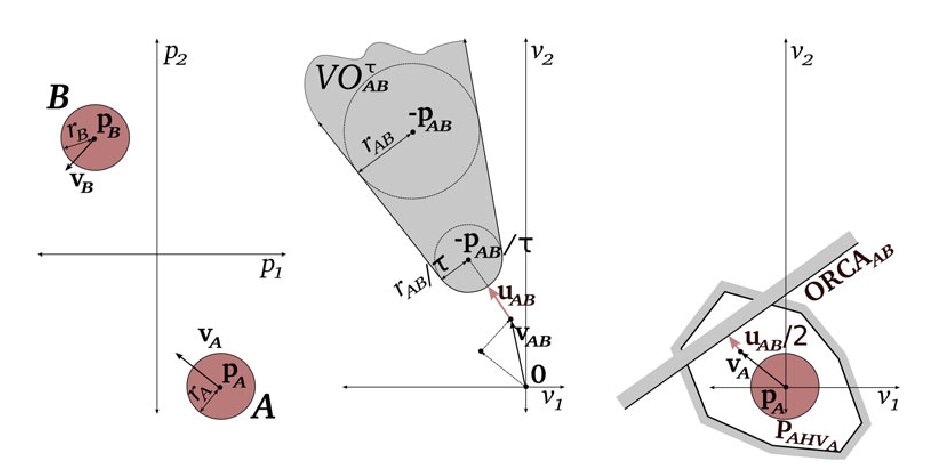 This paper addresses decentralized motion planning among a homogeneous set of feedback-controlled, decision-making agents. It introduces the continuous control obstacle (C^n-CO), which describes the set of C^n-continuous control sequences (and thus trajectories) that lead to a collision between interacting agents. By selecting a feasible trajectory from C^n-CO’s complement, a collision-free motion is obtained. The approach represents an extension to the reciprocal velocity obstacle (RVO, ORCA) collision-avoidance methods so that trajectory segments verify C^n continuity rather than piecewise linearity. This allows the large class of robots capable of tracking C^n-continuous trajectories to employ it for partial motion planning directly—rather than as a mere tool for collision checking. This paper further establishes that both the original velocity obstacle method and several of its recently developed reciprocal extensions (which treat specific robot physiologies only) correspond to particular instances of C^n-CO. In addition to the described extension in trajectory continuity, C^n-CO thus represents a unification of existing RVO theory. Finally, the presented method is validated in simulation—and a parameter study reveals under which environmental and control conditions C^n-CO with n>0 admits significantly improved navigation performance compared with inflated approaches based on ORCA.
                      @article{rufli_TRO13

                      author = {M Rufli and J Alonso-Mora and R Siegwart},

                      title = {Reciprocal Collision Avoidance With Motion Continuity Constraints},

                      journal = {IEEE Transactions on Robotics},

                      volume = {29},

                      number = {4},

                      year = {2013},

                      pages = {1-14}

                      }


