by admin

Keyframe-Based Visual-Inertial SLAM using Nonlinear Optimization

September 20, 2013 in ETHZ-ASL, Publications, year 3 by admin

Stefan Leutenegger, Paul Furgale, Vincent Rabaud, Margarita Chli, Kurt Konolige and Roland Siegwart

Robotics Science and Systems 2013
The fusion of visual and inertial cues has become popular in robotics due to the complementary nature of the two sensing modalities. While most fusion strategies to date rely on filtering schemes, the visual robotics community has recently turned to non-linear optimization approaches for tasks such as visual Simultaneous Localization And Mapping (SLAM), following the discovery that this comes with significant advantages in quality of performance and computational complexity. Following this trend, we present a novel approach to tightly integrate visual measurements with readings from an Inertial Measurement Unit (IMU) in SLAM. An IMU error term is integrated with the landmark reprojection error in a fully probabilistic manner, resulting to a joint non-linear cost function to be optimized. Employing the powerful concept of `keyframes’ we partially marginalize old states to maintain a bounded-sized optimization window, ensuring real-time operation. Comparing against both vision-only and loosely-coupled visual-inertial algorithms, our experiments confirm the benefits of tight fusion in terms of accuracy and robustness.


@inproceedings{leutenegger_rss13,
year = { 2013 },
url = { https://roboticsproceedings.org/rss09/p37.pdf },
title = { Keyframe-Based Visual-Inertial SLAM using Nonlinear Optimization },
month = { 24--28 June },
booktitle = { Proceedings of Robotics: Science and Systems },
author = { Stefan Leutenegger and Paul Furgale and Vincent Rabaud and Margarita Chli and Kurt Konolige and Roland Siegwart },
address = { Berlin, Germany },
}
Article full text

by admin

A Multiple-Camera System Calibration Toolbox Using a Feature Descriptor-Based Calibration Pattern

July 18, 2013 in ETHZ-CVG, Publications, year 3 by admin

Bo Li, Lionel Heng, Kevin Koeser, and Marc Pollefeys

2013 IEEE/RSJ International Conference on Intelligent Robots and Systems

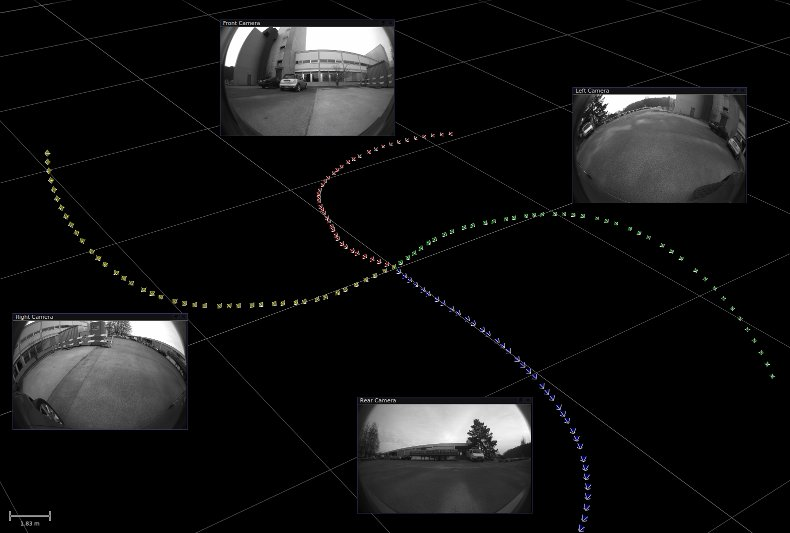
This paper presents a novel feature descriptorbased calibration pattern and a Matlab toolbox which uses the specially designed pattern to easily calibrate both the intrinsics and extrinsics of a multiple-camera system. In contrast to existing calibration patterns, in particular, the ubiquitous chessboard, the proposed pattern contains many more features of varying scales; such features can be easily and automatically detected. The proposed toolbox supports the calibration of a camera system which can comprise either normal pinhole cameras or catadioptric cameras. The calibration only requires that neighboring cameras observe parts of the calibration pattern at the same time; the observed parts may not overlap at all. No overlapping ???elds of view are assumed for the camera system. We show that the toolbox can easily be used to automatically calibrate camera systems.


@inproceedings{liIROS13b,
author = {Bo Li and
Lionel Heng and
Kevin Koeser and
Marc Pollefeys},
title = {A Multiple-Camera System Calibration Toolbox Using a Feature Descriptor-Based Calibration Pattern},
booktitle = {IEEE/RSJ International Conference on Intelligent Robots and Systems (IROS)},
year = {2013},
pages = {}
}

Article full text

by admin

A 4-Point Algorithm for Relative Pose Estimation of a Calibrated Camera with a Known Relative Rotation Angle

July 18, 2013 in ETHZ-CVG, Publications, year 3 by admin

Bo Li, Lionel Heng, Gim Hee Lee, and Marc Pollefeys

2013 IEEE/RSJ International Conference on Intelligent Robots and Systems

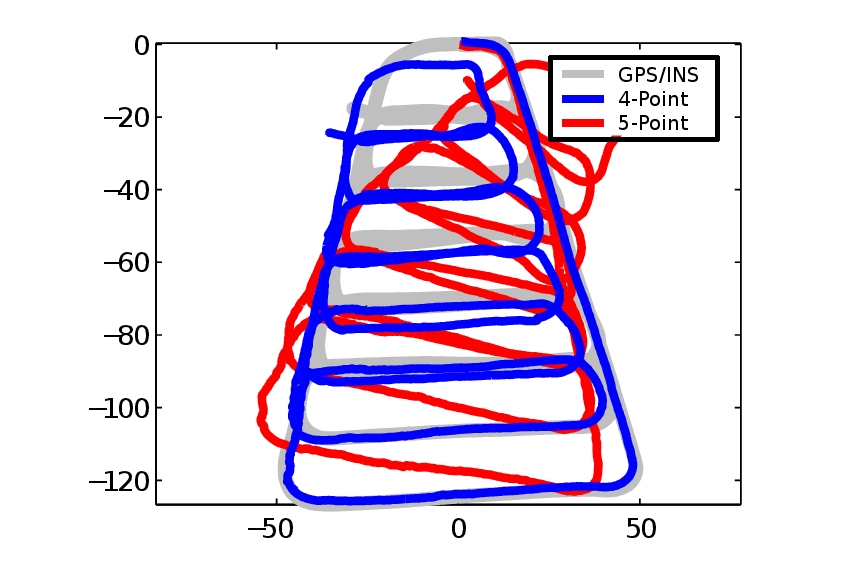
We propose an algorithm to estimate the relative camera pose using four feature correspondences and one relative rotation angle measurement. The algorithm can be used for relative pose estimation of a rigid body equipped with a camera and a relative rotation angle sensor which can be either an odometer, an IMU or a GPS/INS system. This algorithm exploits the fact that the relative rotation angles of both the camera and relative rotation angle sensor are the same as the camera and sensor are rigidly mounted to a rigid body. Therefore, knowledge of the extrinsic calibration between the camera and sensor is not required. We carry out a quantitative comparison of our algorithm with the well-known 5-point and 1-point algorithms, and show that our algorithm exhibits the highest level of accuracy.


@inproceedings{liIROS13a,
author = {Bo Li and
Lionel Heng and
Gim Hee Lee and
Marc Pollefeys},
title = {A 4-Point Algorithm for Relative Pose Estimation of a Calibrated Camera with a Known Relative Rotation Angle},
booktitle = {IEEE/RSJ International Conference on Intelligent Robots and Systems (IROS)},
year = {2013},
pages = {}
}

Article full text

by admin

CamOdoCal: Automatic Intrinsic and Extrinsic Calibration of a Rig with Multiple Generic Cameras and Odometry

July 18, 2013 in ETHZ-CVG, Publications, year 3 by admin

Lionel Heng, Bo Li, and Marc Pollefeys

2013 IEEE/RSJ International Conference on Intelligent Robots and Systems

Multiple cameras are increasingly prevalent on robotic and human-driven vehicles. These cameras come in a variety of wide-angle, fish-eye, and catadioptric models. Furthermore, wheel odometry is generally available on the vehicles on which the cameras are mounted. For robustness, vision applications tend to use wheel odometry as a strong prior for camera pose estimation, and in these cases, an accurate extrinsic calibration is required in addition to an accurate intrinsic calibration. To date, there is no known work on automatic intrinsic calibration of generic cameras, and more importantly, automatic extrinsic calibration of a rig with multiple generic cameras and odometry.

We propose an easy-to-use automated pipeline that handles both intrinsic and extrinsic calibration; we do not assume that there are overlapping fields of view. At the begining, we run an intrinsic calibration for each generic camera. The intrinsic calibration is automatic and requires a chessboard. Subsequently, we run an extrinsic calibration which finds all camera-odometry transforms. The extrinsic calibration is unsupervised, uses natural features, and only requires the vehicle to be driven around for a short time. The intrinsic parameters are optimized in a final bundle adjustment step in the extrinsic calibration. In addition, the pipeline produces a globally-consistent sparse map of landmarks which can be used for visual localization. The pipeline is publicly available as a standalone C++ package.


@inproceedings{hengIROS13,
author = {Lionel Heng and
Bo Li and
Marc Pollefeys},
title = {CamOdoCal: Automatic Intrinsic and Extrinsic Calibration of a Rig with Multiple Generic Cameras and Odometry},
booktitle = {IEEE/RSJ International Conference on Intelligent Robots and Systems (IROS)},
year = {2013},
pages = {}
}

Article full text

by admin

Robust Pose-Graph Loop-Closures with Expectation-Maximization

July 18, 2013 in ETHZ-CVG, Publications, year 3 by admin

Gim Hee Lee, Friedrich Fraundorfer, and Marc Pollefeys

2013 IEEE/RSJ International Conference on Intelligent Robots and Systems

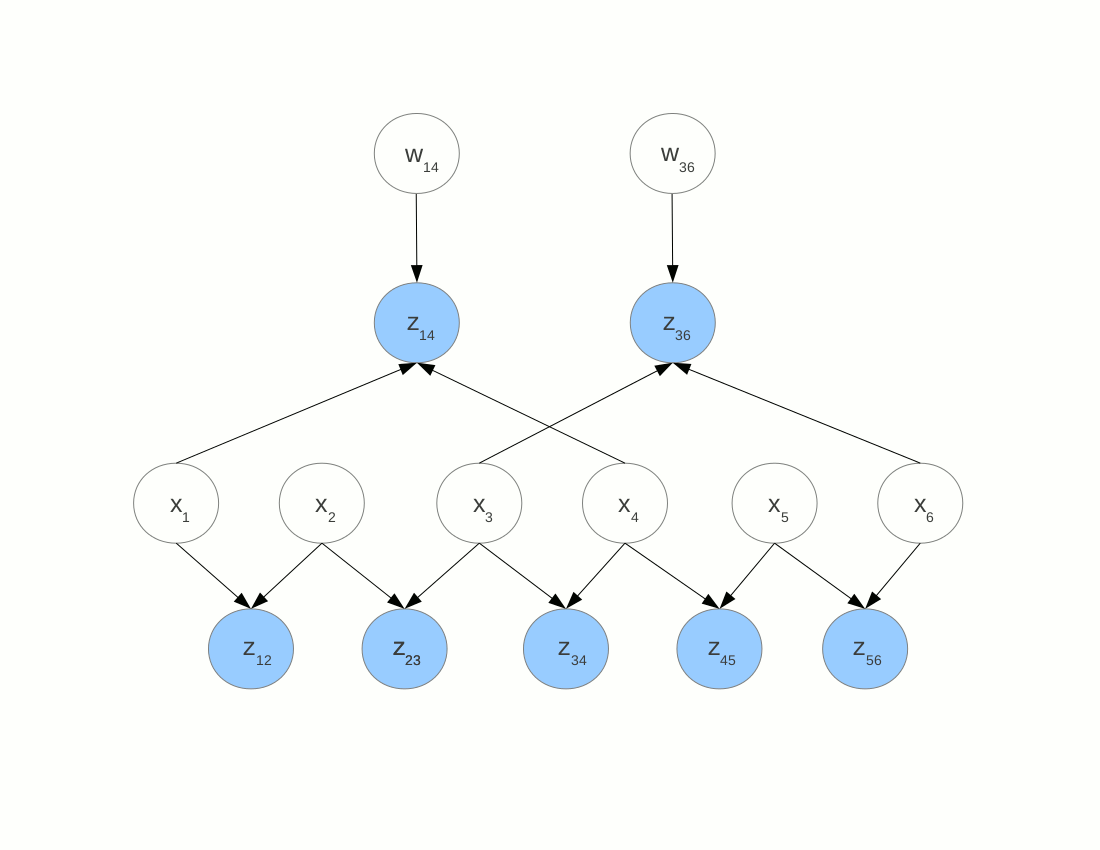
In this paper, we model the robust loop-closure pose-graph SLAM problem as a Bayesian network and show that it can be solved with the Classification Expectation-Maximization (EM) algorithm.
In particular, we express our robust pose-graph SLAM as a Bayesian network where the robot poses and constraints are latent and observed variables. An additional set of latent variables is introduced as weights for the loop-constraints. We show that the weights can be chosen as the Cauchy function, which are iteratively computed from the errors between the predicted robot poses and observed loop-closure constraints in the Expectation step, and used to weigh the cost functions from the pose-graph loop-closure constraints in the Maximization step. As a result, outlier loop-closure constraints are assigned low weights and exert less influences in the pose-graph optimization within the EM iterations.
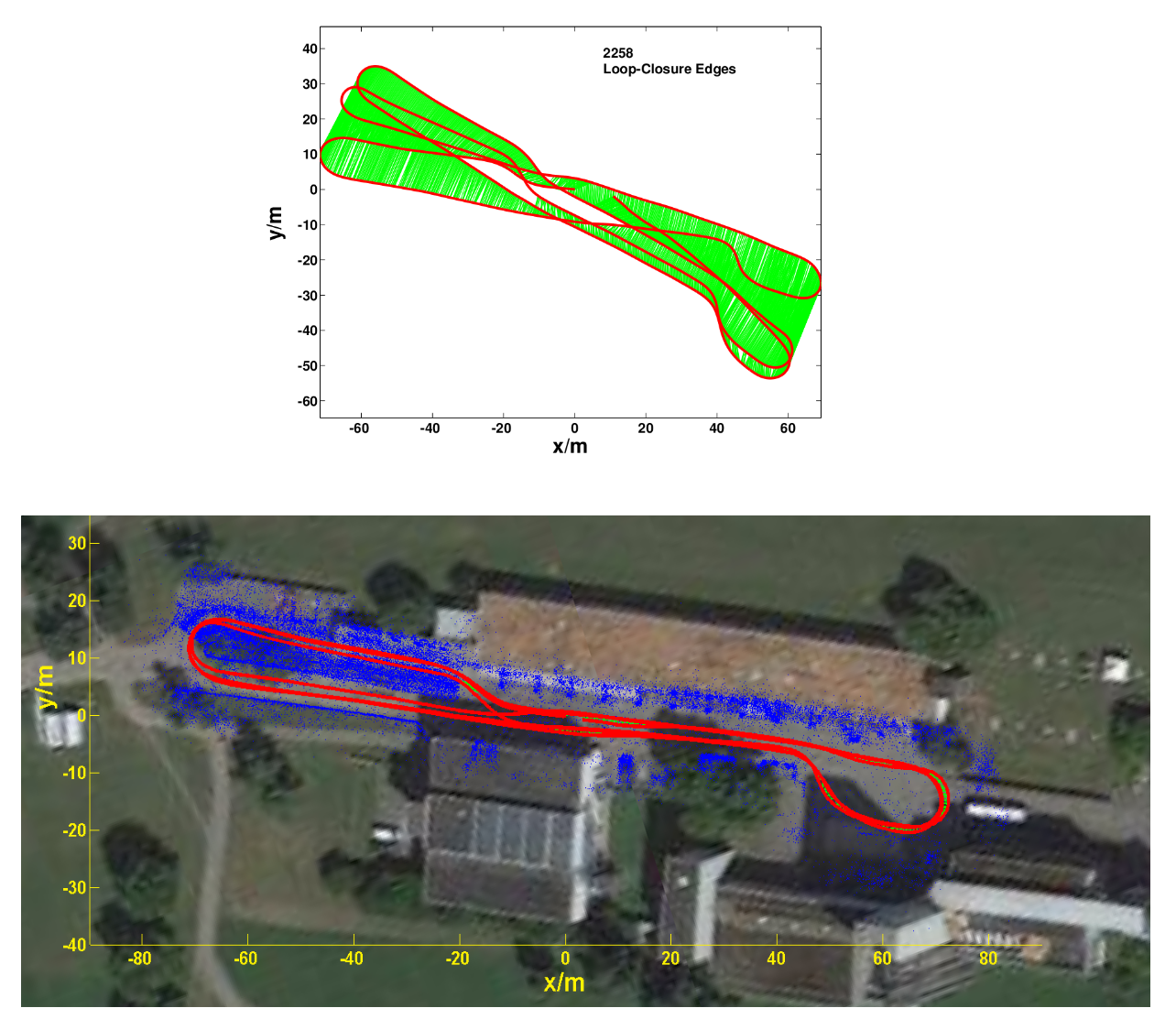
We show proofs of the conceptual similarity between our EM algorithm and the M-Estimator. Specifically, we show that the weight function in our EM algorithm is equivalent to the robust residual function in the M-Estimator. We verify our proposed algorithm with experimental results from multiple simulated and real-world datasets, and comparisons with other +existing works.


@inproceedings{IROS13_Lee_Robust,
author = {Gim Hee Lee and
Friedrich Faundorfer and
Marc Pollefeys},
title = {Robust Pose-Graph Loop-Closures with Expectation-Maximization},
booktitle = {IEEE/RSJ International Conference on Intelligent Robots and Systems (IROS)},
year = {2013},
pages = {}
}

Article full text

by admin

Structureless Pose-Graph Loop-Closure with a Multi-Camera System on a Self-Driving Car

July 18, 2013 in ETHZ-CVG, Publications, year 3 by admin

Gim Hee Lee, Friedrich Fraundorfer, Marc Pollefeys

2013 IEEE/RSJ International Conference on Intelligent Robots and Systems

In this paper, we propose a method to compute the pose-graph loop-closure constraints using multiple non/minimal overlapping field-of-views cameras mounted rigidly on a self-driving car without the need to reconstruct any 3D scene points.
In particular, we show that the relative pose with metric scale between two loop-closing pose-graph vertices can be directly obtained from the epipolar geometry of the multi-cameras system. As a result, we avoid the additional time complexities and uncertainties from the reconstruction of 3D scene points which are needed by standard monocular and stereo approaches. In addition, there is a greater flexibility in choosing a configuration for the multi-camera system to cover a wider field-of-view so as to avoid missing out any loop-closure opportunities.
We show that by expressing the point correspondences between two frames as Pluecker lines and enforcing the planar motion constraint on the car, we are able to use multiple cameras as one and formulate the relative pose problem for loop-closure as a minimal problem which requires 3-point correspondences that yields up to six real solutions. The RANSAC algorithm isused to determine the correct solution and for robust estimation. We verify our method with results from multiple large-scale real-world data.


@inproceedings{IROS13_Lee_Structureless,
author = {Gim Hee Lee and
Friedrich Faundorfer and
Marc Pollefeys},
title = {Structureless Pose-Graph Loop-Closure with a Multi-Camera System on a Self-Driving Car},
booktitle = {IEEE/RSJ International Conference on Intelligent Robots and Systems (IROS)},
year = {2013},
pages = {}
}

Article full text

by admin

Introspective Active Learning for Scalable Semantic Mapping

July 2, 2013 in Oxford-MRG, Publications, year 3 by admin

Rudolph Triebel, Hugo Grimmett, Rohan Paul, Ingmar Posner

Workshop. Robotics Science and Systems (RSS)

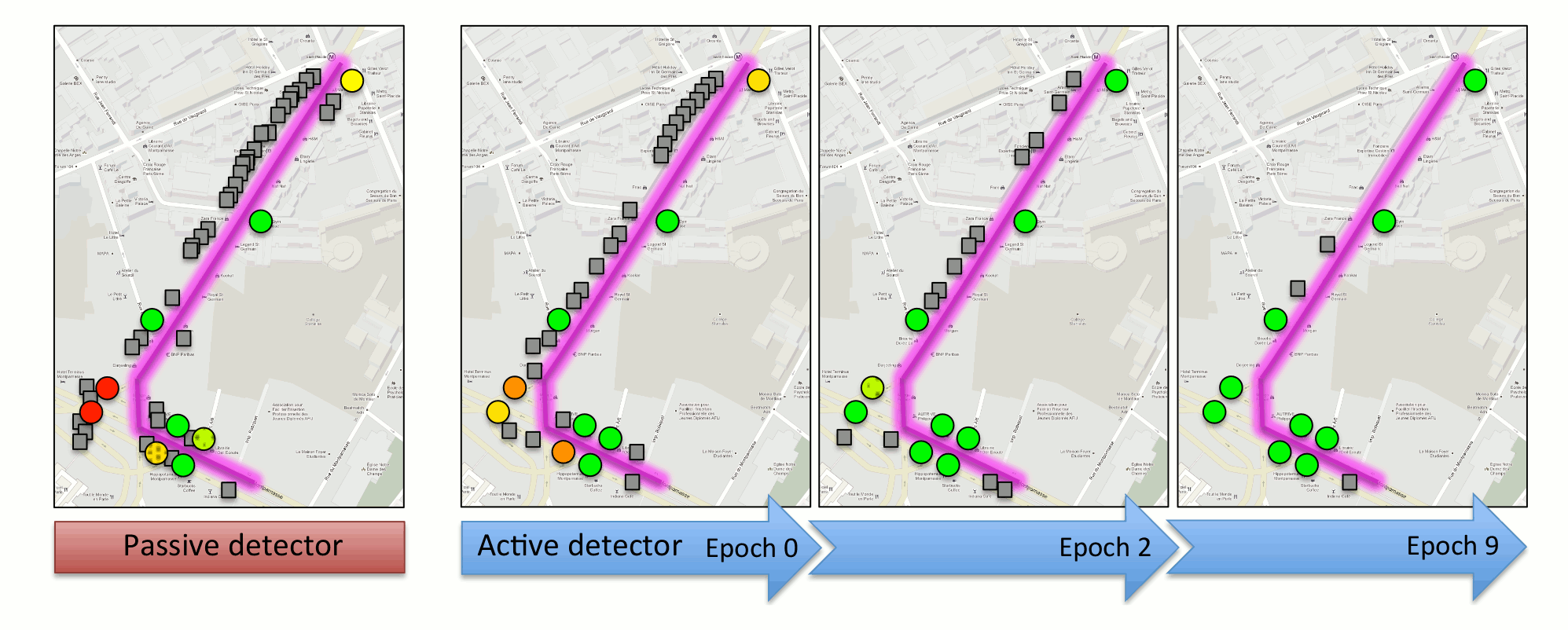
This paper proposes an active learning framework for semantic mapping in mobile robotics. In particular, our work explores the benefits of an introspective classifier over that of a more traditional non-introspective approach for active data selection. We extend the notion of introspection to a particular sparse Gaussian Process classifier, the Informative Vector Machine (IVM), and show that the use of an IVM leads to more informative questions being asked during active learning. We further leverage the information-theoretic nature of the IVM to formulate a principled mechanism for forgetting stale data. The result is an efficient and highly effective end-to-end active learning framework which outperforms both passive approaches as well as active approaches based on the more commonly used Support Vector Machine (SVM) in terms of classification performance and learning rate on a publicly available dataset.


@INPROCEEDINGS { TriebelRSSWorkshop2013,
AUTHOR = { Rudolph Triebel, Hugo Grimmett, Rohan Paul, Ingmar Posner },
BOOKTITLE = { Workshop. Robotics Science and Systems (RSS) },
MONTH = jun,
TITLE = {Introspective Active Learning for Scalable Semantic Mapping },
YEAR = { 2013 },
}