The V-Charge project is going to be presented at the annual conference and general meeting of the swiss association for e-mobility on July 28th, 2014. For further information and online registration visit https://www.e-mobile.ch.
Gim Hee Lee, Marc Pollefeys, and Friedrich Fraundorfer
2014 IEEE International Conference on Computer Vision and Pattern Recognition (CVPR)
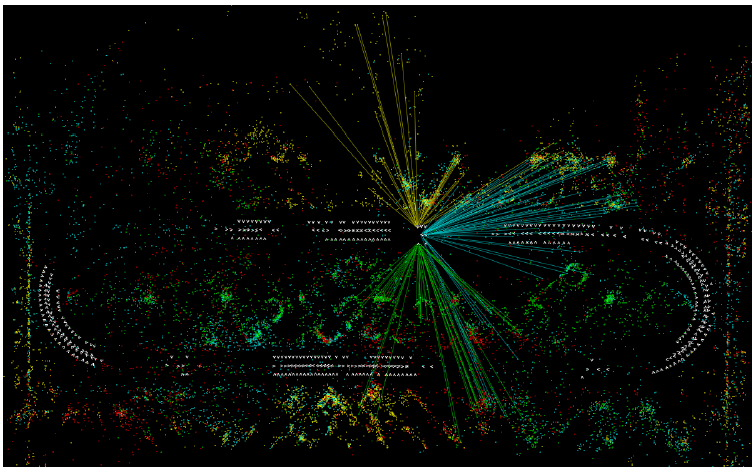
In this paper, we present our minimal 4-point and linear 8-point algorithms to estimate the relative pose of a multi-camera system with known vertical directions, i.e. known absolute roll and pitch angles. We solve the minimal 4-point algorithm with the hidden variable resultant method and show that it leads to an 8-degree univariate polynomial that gives up to 8 real solutions. We identify a degenerated case from the linear 8-point algorithm when it is solved with the standard Singular Value Decomposition (SVD) method and adopt a simple alternative solution which is easy to implement. We show that our proposed algorithms can be efficiently used within RANSAC for robust estimation. We evaluate the accuracy of our proposed algorithms by comparisons with various existing algorithms for the multi-camera system on simulations and show the feasibility of our proposed algorithms with results from multiple real-world datasets.
                      @inproceedings{leeCVPR14,

                      author = {Gim Hee Lee and

                      Marc Pollefeys and

                      Friedrich Fraundorfer},

                      title = {Relative Pose Estimation for a Multi-Camera System with Known Vertical Direction},

                      booktitle = {IEEE International Conference on Computer Vision and Pattern Recognition (CVPR)},

                      year = {2014},

                      pages = {}

                      }
Christian Haene, Nikolay Savinov, and Marc Pollefeys
2014 IEEE International Conference on Computer Vision and Pattern Recognition (CVPR)
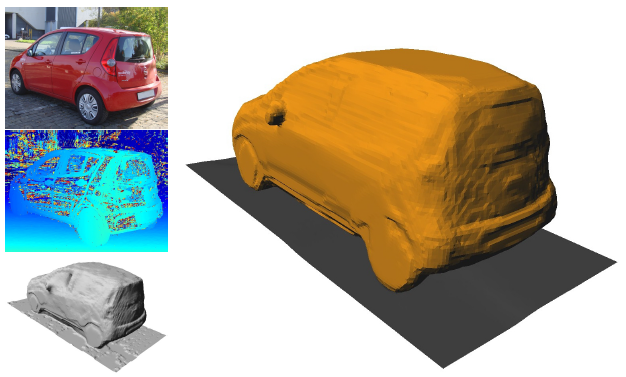
Dense 3D reconstruction of real world objects containing textureless, reflective and specular parts is a challenging task. Using general smoothness priors such as surface area regularization can lead to defects in the form of disconnected parts or unwanted indentations. We argue that this problem can be solved by exploiting the object class specific local surface orientations, e.g. a car is always close to horizontal in the roof area. Therefore, we formulate an object class specific shape prior in the form of spatially varying anisotropic smoothness terms. The parameters of the shape prior are extracted from training data. We detail how our shape prior formulation directly fits into recently proposed volumetric multi-label reconstruction approaches. This allows a segmentation between the object and its supporting ground. In our experimental evaluation we show reconstructions using our trained shape prior on several challenging datasets.
                      @inproceedings{haeneCVPR14,

                      author = {Christian Haene and

                      Nikolay Savinov and

                      Marc Pollefeys},

                      title = {Class Specific 3D Object Shape Priors Using Surface Normals},

                      booktitle = {IEEE International Conference on Computer Vision and Pattern Recognition (CVPR)},

                      year = {2014},

                      pages = {}

                      }
2014 IEEE International Conference on Robotics and Automation (ICRA)
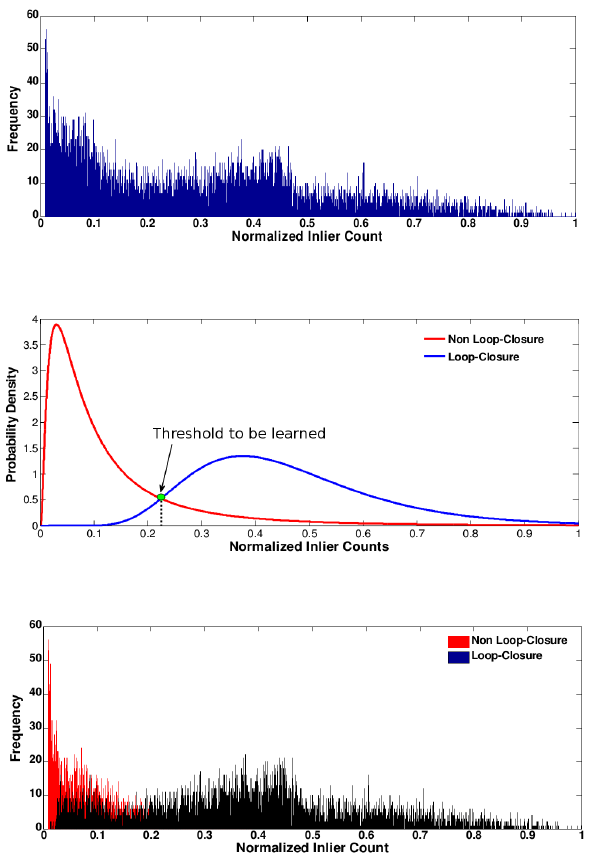
A potential loop-closure image pair passes the geometric verification test if the number of inliers from the computation of the geometric constraint with RANSAC exceed a pre-defined threshold. The choice of the threshold is critical to the success of identifying the correct loop-closure image pairs. However, the value for this threshold often varies for different datasets and is chosen empirically. In this paper, we propose an unsupervised method that learns the threshold for geometric verification directly from the observed inlier counts of all the potential loop-closure image pairs. We model the distributions of the inlier counts from all the potential loop-closure image pairs with a two components Log-Normal mixture model – one component represents the state of non loop-closure and the other represents the state of loop-closure, and learn the parameters with the Expectation-Maximization algorithm. The intersection of the Log-Normal mixture distributions is the optimal threshold for geometric verification, i.e. the threshold that gives the minimum false positive and negative loop-closures. Our algorithm degenerates when there are too few or no loop-closures and we propose the ^_chi-squared test to detect this degeneracy. We verify our proposed method with several large-scale datasets collected from both the multi-camera setup and stereo camera.
                      @inproceedings{leeICRA14,

                      author = {Gim Hee Lee and

                      Marc Pollefeys},

                      title = {Unsupervised Learning of Threshold for Geometric Verification in Visual-Based Loop-Closure},

                      booktitle = {IEEE International Conference on Robotics and Automation (ICRA)},

                      year = {2014},

                      pages = {}

                      }
Lionel Heng, Mathias Buerki, Gim Hee Lee, Paul Furgale, Roland Siegwart, and Marc Pollefeys
2014 IEEE International Conference on Robotics and Automation (ICRA)
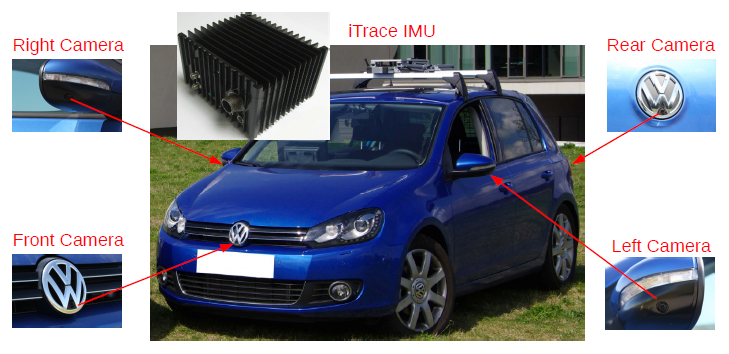
The online recalibration of multi-sensor systems is a fundamental problem that must be solved before complex automated systems are deployed in situations such as automated driving. In such situations, accurate knowledge of calibration parameters is critical for the safe operation of automated systems. However, most existing calibration methods for multi-sensor systems are computationally expensive, use installations of known fiducial patterns, and require expert supervision. We propose an alternative approach called infrastructure-based calibration that is efficient, requires no modification of the infrastructure, and is completely unsupervised. In a survey phase, a computationally expensive simultaneous localization and mapping (SLAM) method is used to build a highly accurate map of a calibration area. Once the map is built, many other vehicles are able to use it for calibration as if it were a known fiducial pattern.
We demonstrate the effectiveness of this method to calibrate the extrinsic parameters of a multi-camera system. The method does not assume that the cameras have an overlapping field of view and it does not require an initial guess. As the camera rig moves through the previously mapped area, we match features between each set of synchronized camera images and the map. Subsequently, we find the camera poses and inlier 2D-3D correspondences. From the camera poses, we obtain an initial estimate of the camera extrinsics and rig poses, and optimize these extrinsics and rig poses via non-linear refinement. The calibration code is publicly available as a standalone C++ package.
                      @inproceedings{hengICRA14,

                      author = {Lionel Heng and

                      Mathias Buerki and

                      Gim Hee Lee and

                      Paul Furgale and

                      Roland Siegwart and

                      Marc Pollefeys},

                      title = {Infrastructure-Based Calibration of a Multi-Camera Rig},

                      booktitle = {IEEE International Conference on Robotics and Automation (ICRA)},

                      year = {2014},

                      pages = {}

                      }
Collaborative development of automated parking and charging for electric vehicles
Electric vehicles hold the promise of sustainable mobility for the years ahead. But current technology has significant limitations such as reduced driving ranges and long charging times. As such, today’s electric cars are not yet a realistic alternative to conventionally powered vehicles when considering long-distance journeys. This is why scientists are developing novel approaches that combine not only short- and long-haul travel but also public and private modes of transportation. One such concept is currently being developed by a team of researchers at ETH Zurich and the universities of Braunschweig, Oxford, and Parma, in collaboration with industrial partners Bosch and Volkswagen AG. Their EU-funded project is called V-Charge, which stands for “valet parking and charging,” and it envisions a world in which travelers complete most interurban journeys using a well-developed long-distance transportation network and then switch to comfortable electric vehicles for the last few miles home from the railway station. To support this vision, the researchers are developing V-Charge park & ride car parks, where fully automated electric vehicles will be able to make their way to charging stations or parking spaces. Travelers simply use a smartphone app to send their vehicle to charge itself. Once it is fully charged, they can summon it just as easily via the app to come and pick them up.
Vehicles will avoid collisions
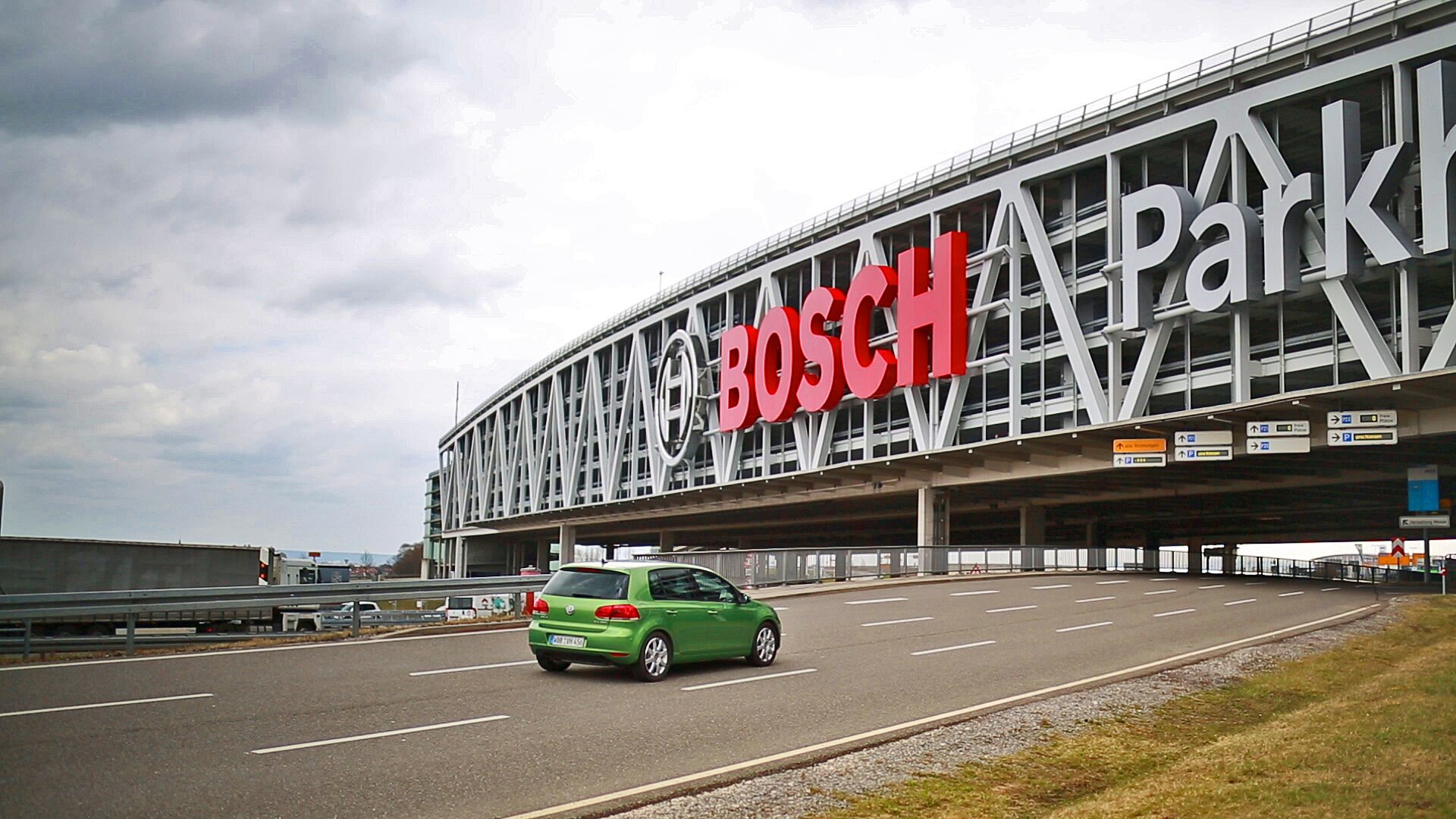
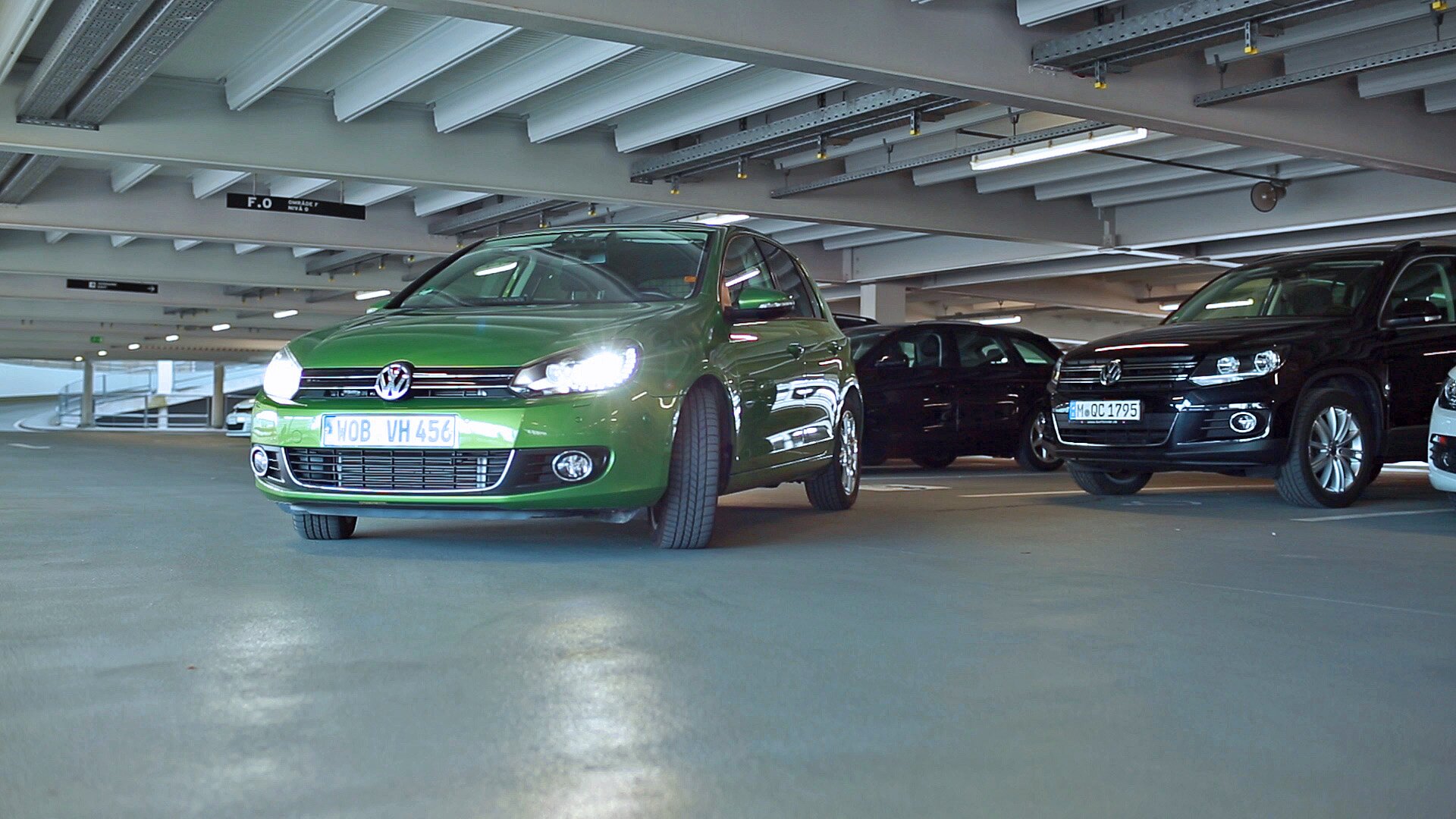
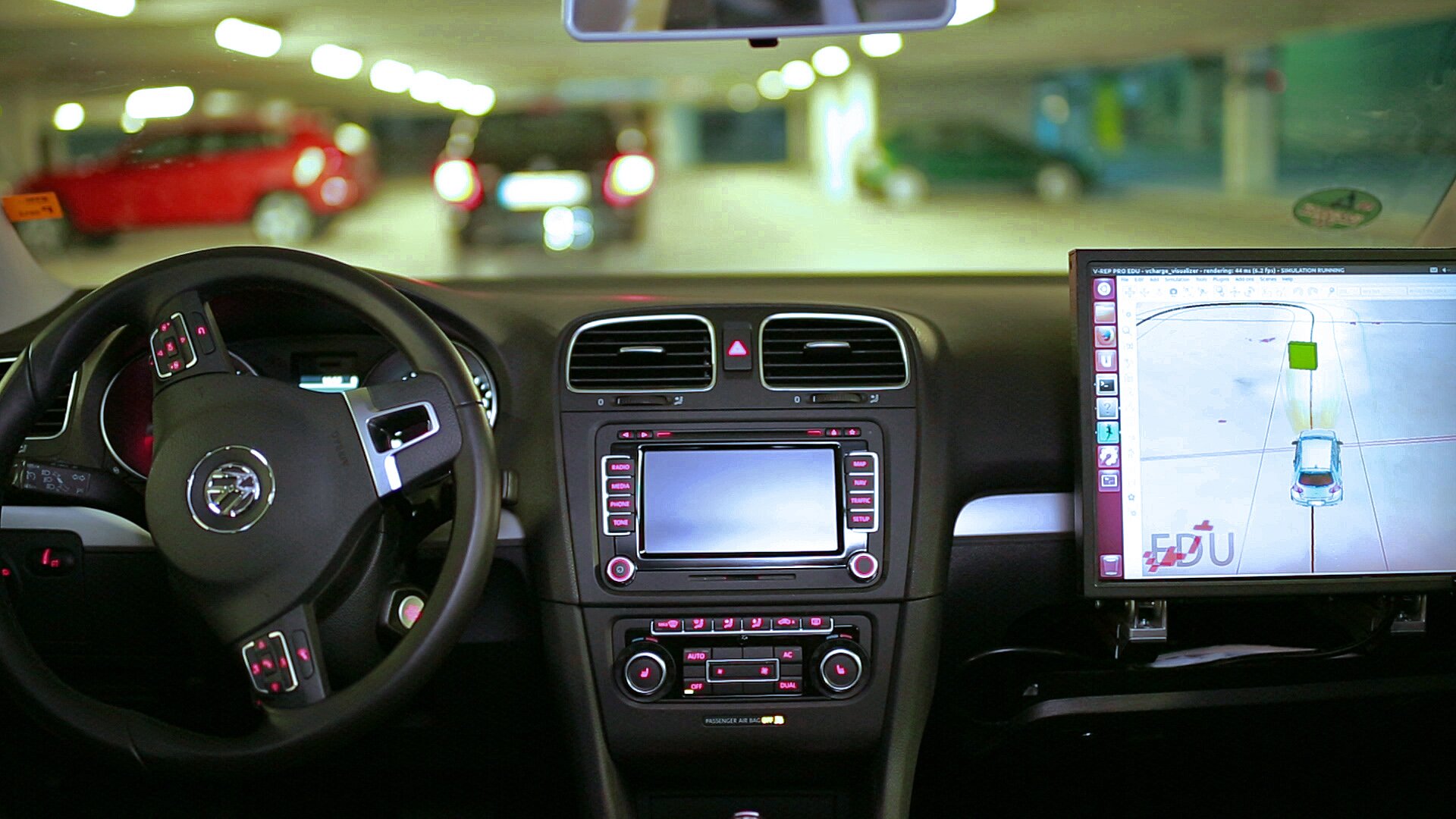
The project was launched in June 2011 and reached an important milestone on April 2, 2014, when the scientists presented the latest version of their fully automated driving and parking function in the Bosch parking garage at Stuttgart airport. They successfully demonstrated fully automated valet parking triggered from a smartphone app. After receiving the trigger, the vehicle connects to the parking garage’s server, determines the location of a vacant parking space, and then drives itself to that space. If another vehicle crosses its path, the vehicle either stops to let it pass or maneuvers to avoid it.
Pooling expertise to deliver a cost-effective solution
It is not possible to use GPS to locate vehicles inside parking garages as the building obstructs satellite signals. Instead, the scientists have developed a camera-based system that relies on the team’s pooled expertise in the fields of robotics and environment sensing. The first step is for the vehicle to connect with the parking garage infrastructure and download special map for determining its precise location. The map contains a description of the surroundings that is specifically designed to be used with camera sensors. The vehicle can determine its position by comparing the data its cameras collect at any given time with data from the map.
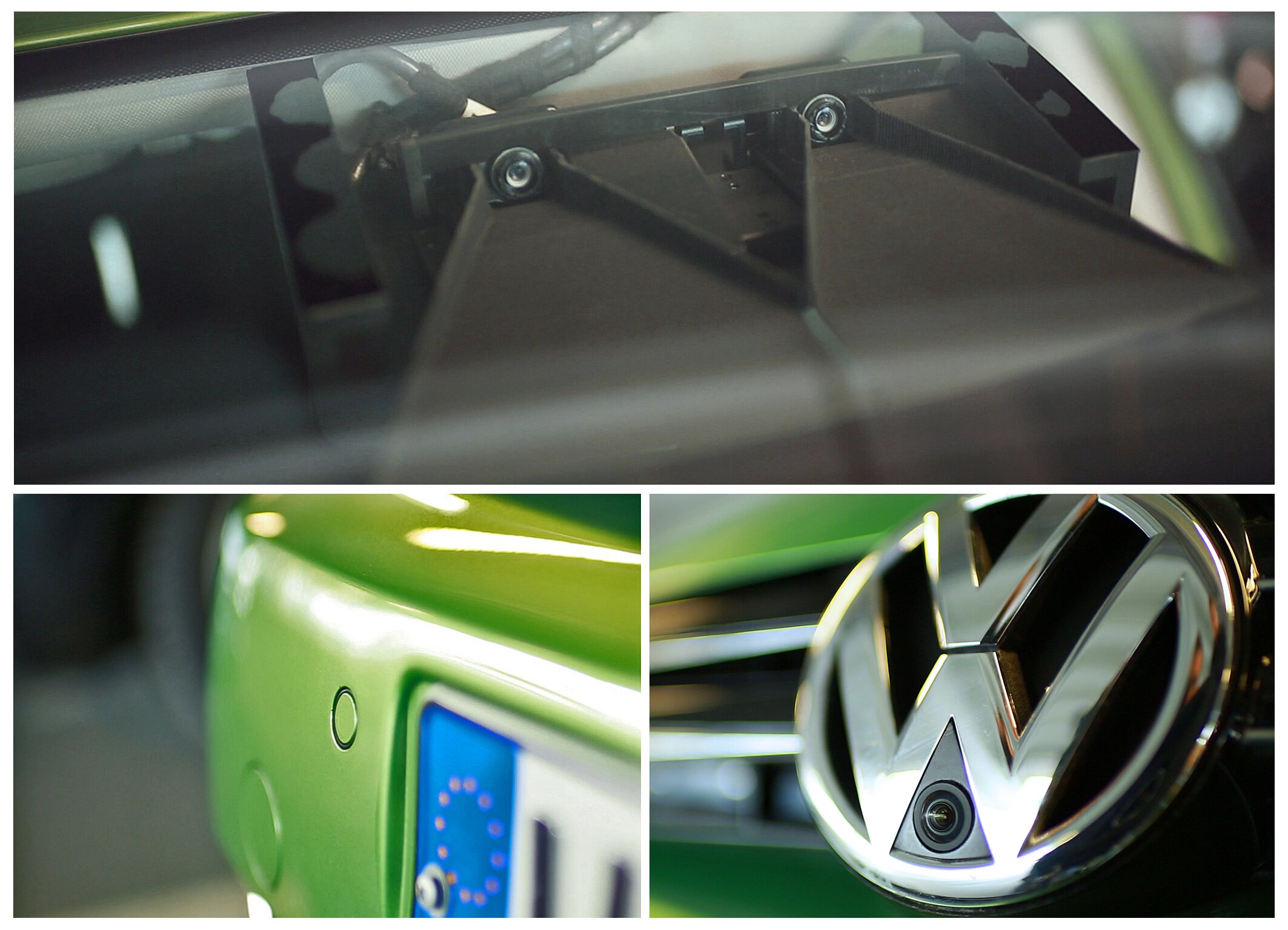
Any obstacles are detected by a stereo camera and then either recognized as static or identified as another road user currently in motion. Several times a second, the vehicle recalculates the optimum sequence of driving maneuvers that will allow it to avoid both static and moving objects. The aim is to make the functions outlined here cost-effective enough to appeal to the market so that they can be integrated into series production in the near future. This is why the engineers deliberately avoided sensor systems that are not suitable for series production. Instead they are working with equipment that is already available today, including the ultrasonic sensors and stereo cameras that are used in parking assistance and emergency braking systems.
With the project set to conclude in 2015, the team will now continue to refine all aspects of this system. One central aspect is the accuracy of parking maneuvers. In order to charge themselves automatically, electric vehicles of the future will have to approach charging stations with particular precision. Reliable navigation is another focus of the project’s work. It needs to be ensured that vehicles can deal reliably with any situation that arises, even when faced with strongly fluctuating lighting conditions, heavy traffic in which other vehicles are being controlled manually, and areas shared with pedestrian traffic.
V-Charge is a collaborative research project being coordinated by ETH Zurich with contributions from the universities of Braunschweig, Oxford, and Parma together with Bosch and Volkswagen AG. The project is receiving funding from the EU’s Seventh Framework Programme for Research (V-Charge, project number 269916) and has an overall budget of 5.63 million euros. It is set to run from June 1, 2011 to September 30, 2015.
The EU V-Charge project will host a summer school on fully automated driving.
The summer school will give a compact introduction to the field of fully automated driving, offer technical sessions that will provide
hands-on experience with state-of-the-art techniques, and present invited talks to frame the open research questions in the field.
Gim Hee Lee, Bo Li, Marc Pollefeys, and Friedrich Fraundorfer
International Symposium on Robotics Research (ISRR) 2013
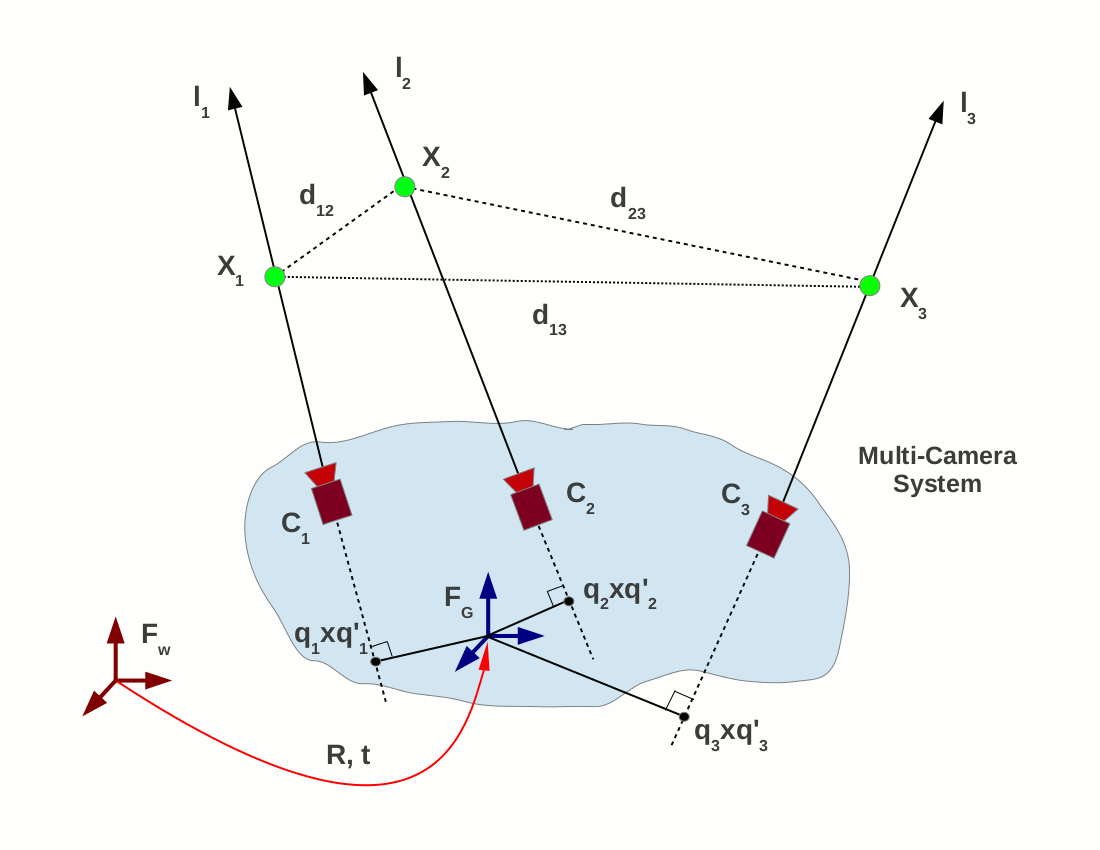
In this paper, we propose a novel formulation to solve the pose estimation problem of a calibrated multi-camera system.
The non-central rays that pass through the 3D world points and multi-camera system are elegantly represented as Pluecker lines. This allows us to solve for the depth of the points along the Pluecker lines with a minimal set of 3-point correspondences.
We show that the minimal solution for the depth of the points along the Pluecker lines is an 8 degree polynomial that gives up to 8 real solutions.
The coordinates of the 3D world points in the multi-camera frame are computed from the known depths. Consequently, the pose of the multi-camera system, i.e. the rigid transformation between the world and multi-camera frames can be obtained from absolute orientation.
We also derive a closed-form minimal solution for the absolute orientation. This removes the need for the computationally expensive Singular Value Decompositions (SVD) during the evaluations of the possible solutions for the depths. We identify the correct solution and do robust estimation with RANSAC.
Finally, the solution is further refined by including all the inlier correspondences in a non-linear refinement step. We verify our approach by showing comparisons with other existing approaches and results from large-scale real-world datasets.
                      @inproceedings{leeISRR13,

                      author = {Gim Hee Lee, Bo Li, Marc Pollefeys, and Friedrich Fraundorfer},

                      title = {Minimal Solutions for Pose Estimation of a Multi-Camera System},

                      booktitle = {International Symposium on Robotics Research (ISRR) 2013},

                      year = {2013}

                      }
IEEE Transactions on Intelligent Transportation Systems (Journal)
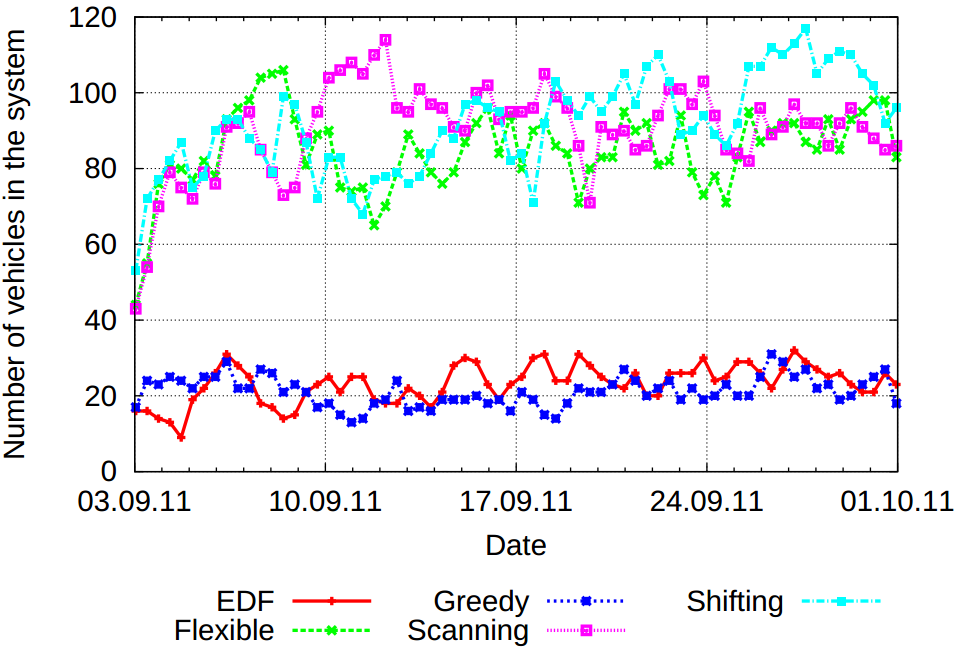
Electric vehicles (EVs) still have relatively long and frequent charging cycles. Moreover, charging resources are typically limited and must therefore be used efficiently. The V-Charge project has the vision to provide a solution by combining autonomous valet parking with e-mobility, introducing improved parking and charging comfort. V-Charge proposes a solution for charging autonomous EVs in parking places and efficiently using scarce charging resources, thus simplifying the life of the customer and increasing the feasibility of EVs. For the management of parking lots and charging resources, V-Charge provides a server back end and a communication infrastructure. In this paper, we present our design of scheduling concepts for a coordinated charging strategy that is implemented by this back end. Through intensive simulations, we show that the V-Charge server is able to efficiently handle realistic parking volume and performs well in fulfilling customer requirements, e.g., energy demand for the next driving tasks. Moreover, we evaluate the suitability of various scheduling strategies in different usage scenarios. For the simulation setup, real-world parking statistics obtained from Hamburg Airport and the City of Braunschweig, Germany, are used.
                      @article{Timpner:TITS:2013,

                      author = {Timpner, Julian and Wolf, Lars},

                      doi = {10.1109/TITS.2013.2283805},

                      journal = {IEEE Transactions on Intelligent Transportation Systems},

                      publisher = {IEEE},

                      title = {{Design and Evaluation of Charging Station Scheduling Strategies for Electric Vehicles}},

                      year = {2013},

                      month=nov,

                      volume=PP,

                      number=99,

                      issn={1524-9050},

                      URL={https://ieeexplore.ieee.org/xpl/articleDetails.jsp?arnumber=6651804},

                      }
Tobias Pögel, Julian Timpner, Stephan Rottmann and Lars C. Wolf
PIK – Praxis der Informationsverarbeitung und Kommunikation (Journal)
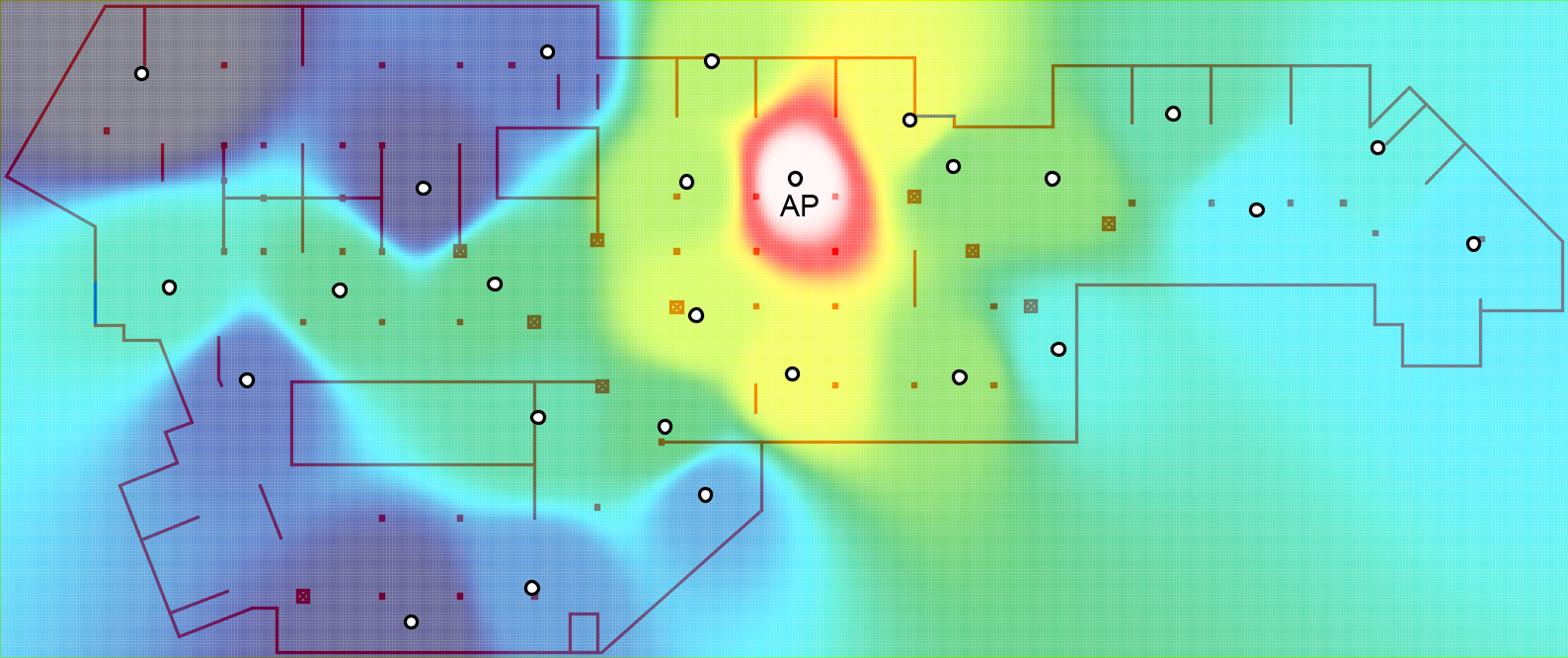
In this paper different parking scenarios for autonomous vehicles are considered. For control and monitoring purposes reliable Wi–Fi-based communication between the vehicles and a back-end is needed. It must be ensured that potential QoS requirements of different applications are met and that vehicles do not hit so-called “white spots” without any network connectivity. The network properties are represented and estimated by a Connectivity Map. For this purpose, network and measurement data are continuously collected so that other vehicles can be provided with the newly gained knowledge, which allows the planning of the proposed scenarios. This paper shows potential QoS requirements and discusses the necessary steps for the realization of such a Connectivity Map.
In addition to the automated continuous collection of relevant network parameters as a byproduct of vehicular communications, the mapping of the scenarios in terms of floor plans with additional meta-information as well as the representation of connectivity properties are shown.
We outline our vision for using the developed Connectivity Map for advanced parking management decisions.
                      @ARTICLE{Poegel:PIK:2013,

                      AUTHOR={Tobias {P{\"o}gel} and Julian Timpner and Stephan Rottmann and Lars C Wolf},

                      TITLE="Estimation of Vehicular Connectivity in Autonomous Parking Scenarios",

                      JOURNAL="PIK - Praxis der Informationsverarbeitung und Kommunikation",

                      PAGES={243-248},

                      VOLUME=36,

                      NUMBER=4,

                      DAYS=1,

                      MONTH=dec,

                      YEAR=2013,

                      URL={https://www.degruyter.com/view/j/piko-2013-36-issue-4/pik-2013-0026/pik-2013-0026.xml},

                      }