 by
by Lighting-Invariant Adaptive Route Following Using ICP
January 21, 2015 in Journals, Publications, year 4 by admin
Philipp Krüsi, Bastian Bücheler, Francois Pomerleau, Ulrich Schwesinger, Roland Siegwart, and Paul Furgale
Journal of Field Robotics, 2014
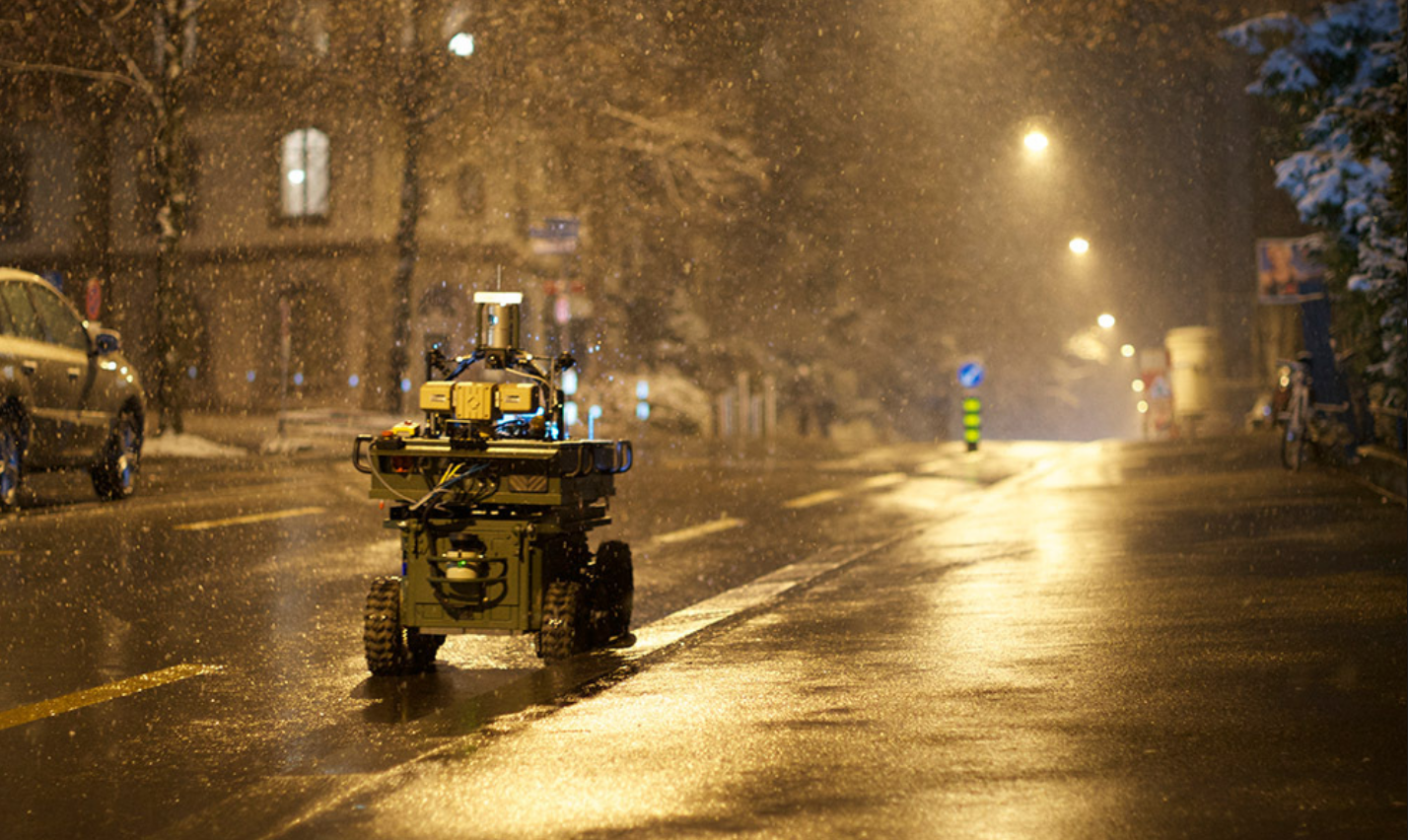 Topological/metric route following, also called teach and repeat (T&R), enables long-range autonomous navigation even without globally consistent localization. In the teach pass, the robot is driven manually and builds up a topological/metric map of the environment: a graph of metric submaps connected by relative transformations. For repeating the route autonomously, the map only needs to be locally consistent; errors on the global level due to localization drift are irrelevant. This renders T&R ideal for applications where a global positioning system may not be available, such as navigation through street canyons or forests in search and rescue, reconnaissance in underground structures, surveillance, or planetary exploration.
We present a T&R system based on iterative closest point matching (ICP) using data from a spinning three-dimensional (3D) laser scanner. Our algorithm is highly accurate, robust to dynamic scenes and extreme changes in the environment, and independent of ambient lighting. It enables autonomous navigation along a taught path in both structured and unstructured environments, including highly 3D terrain. Furthermore, our system is able to detect obstacles and avoid them by adapting its path using a local motion planner. It enables autonomous route following in non-static environments, which is not possible with classical T&R systems.
We demonstrate our algorithm’s performance in two long-range driving experiments, one in a highly dynamic urban environment, the other in unstructured, rough, 3D terrain. In these experiments our robot autonomously drove a distance of over 22 kilometers in both day and night. We analyze the localization accuracy of our system and show that it is highly precise. Moreover, we compare our ICP-based method to a state-of-the-art stereo-vision-based technique and show that our approach has a greatly increased robustness to path deviations and is less dependent on environmental conditions.
                      @article{kruesi_jfr14,

                      note = { Accepted for publication on March 31, 2014. },

                      journal = { Journal of Field Robotics },

                      year = { 2014 },

                      title = { Lighting-Invariant Adaptive Route Following Using ICP },

                      author = { Philipp Kr\"{u}si and Bastian B\"{u}cheler and Fran\c{c}ois Pomerleau and Ulrich Schwesinger and Roland Siegwart and Paul Furgale },

                      }


